


Teacher Tested Piano Bench Height: Elbows Level With the Keyboard

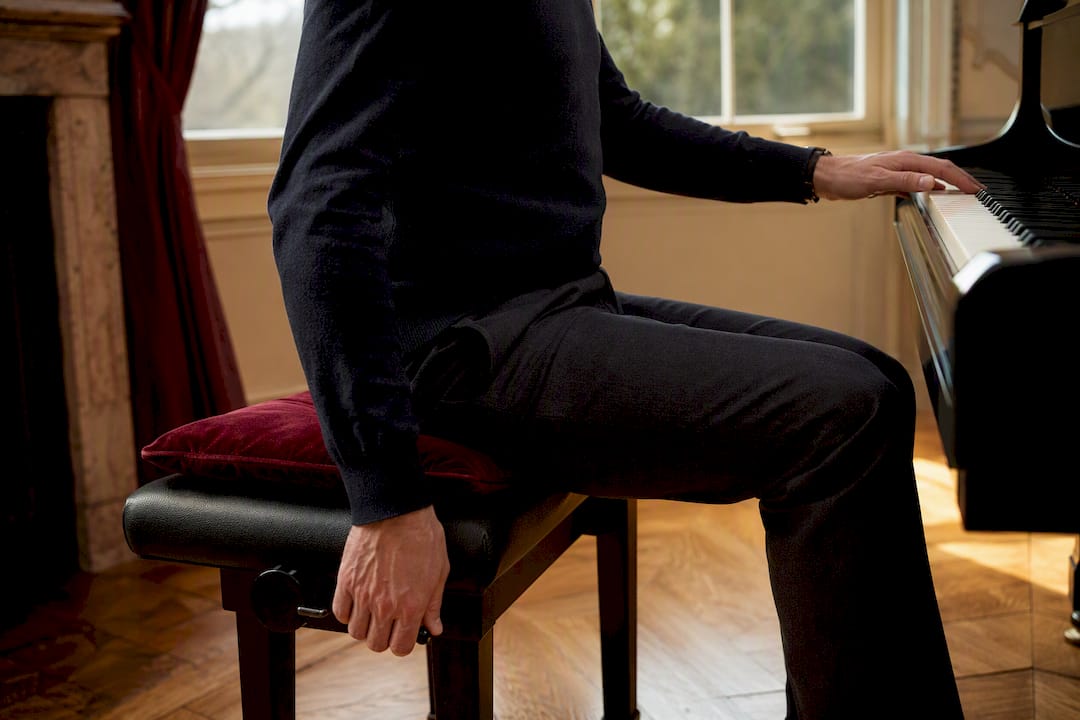
The correct piano bench height puts your elbows level with the keyboard, forearms roughly parallel to the floor, feet flat on the ground. Most players land somewhere between 18 and 24 inches (45 to 60 cm), though the exact figure depends on your height and your instrument. Fixed benches work fine if only one person plays; households with children or mixed heights are better off with an adjustable bench, and kids often need a footstool until they grow into the seat.
TL;DR:
Most players need an adjustable bench with a height range of about 18 to 24 inches to accommodate different body types and shared household setups.
Checking elbow level with the keyboard before every session ensures proper posture, reducing shoulder tension and improving technique.
Fixed benches can work for consistent players, but adjustable models are essential for growing children and households with multiple users.
Avoid soft cushions or stacking cushions loosely, as they destabilize posture and lead to inefficient or strained playing.
Regularly re-evaluate bench height during growth spurts or after long periods of use to prevent the development of tension habits that are harder to correct later.
Table of Contents
What is the ideal piano bench height?
There’s no single number that fits every player, because keyboard height itself varies. A typical piano keyboard sits about 72 to 75 cm from the floor, which is why Roberts Pianos recommends choosing your bench relative to the instrument rather than assuming one height suits every setup. Get that relationship wrong and no amount of technique practice will fix the tension it creates in your shoulders and wrists.
Most manufacturers build standard benches around 18 to 20 inches (45 to 50 cm), with adjustable models extending up to roughly 24 inches (60 cm). That gives a practical working range of about 18 to 24 inches (45 to 60 cm), according to Piano Technician Tuner. Here’s how that breaks down in practice:
Shorter adults or younger teens: closer to 18 to 19 inches (45 to 48 cm)
Average adult height: around 19 to 20 inches (48 to 51 cm)
Taller players: 21 inches and above (53 cm+), often needing an adjustable bench to reach it
Shared households: adjustable range covering the full 18 to 24 inch span is worth the extra cost
If your bench only offers one fixed height and it doesn’t match your build, that’s the first thing to change. Everything else in your posture, from wrist angle to pedal reach, follows from getting this one measurement right.
How to check and adjust your bench height
Checking your setup takes two minutes and needs no special tools beyond your own hands and eyes.
Sit on the front half of the bench. Feet flat on the floor, shoulders relaxed, weight resting on your sit bones rather than sunk back into the seat.
Place your hands on the keys around middle C. Look at your elbows. They should sit level with the keyboard, or very slightly above it, with your forearms close to parallel with the floor. Yamaha’s posture guidance confirms this is the benchmark worth building every other adjustment around.
Adjust in small increments. If your bench has two side knobs, turn them the same amount each time. Uneven turns tilt the seat, which throws off your balance more than people expect. West Island Music Academy recommends making hydraulic adjustments while seated, checking evenness after each small change rather than guessing and re-sitting repeatedly.
Check pedal reach last. Once elbow height is correct, confirm your foot can reach the pedals without stretching or losing contact with the floor.
Run through this quick checklist before every serious practice session: elbows level, shoulders down, feet flat or resting on a footstool, wrists free to move without strain.
Pro Tip: Play a slow five-note scale right after adjusting. If your shoulders creep up or your wrist locks by the third note, the bench still isn’t right, even if it looked fine when you were sitting still.
Adjustable, fixed, or duet: which bench type fits your home?
Adjustable benches use either a mechanical screw system or hydraulic lift, and they solve the biggest practical problem in shared households: nobody’s body matches anyone else’s. A parent, a teenager, and a younger sibling all need different heights, and swapping cushions between lessons wastes time and rarely gets the geometry right anyway.
Fixed benches are cheaper and sturdier, and they’re perfectly fine if one person plays consistently and the height already suits them. Duet benches, built for two players side by side, look convenient but often compromise both players’ posture at once. Roberts Pianos points out that two separate adjustable benches usually beat one shared duet bench when the players differ in height, since each person can set their own elbow line independently.
If you’re stuck with a bench that’s too low right now:
Use a firm, stable cushion rather than a soft, compressible one, which shifts under you mid-piece and destabilises your base
Avoid stacking cushions loosely. A single firm platform is safer than a wobbly pile
Don’t reach for an office chair as a substitute. Armrests and backrests encourage passive sitting, and if you must use one temporarily, remove the armrests and sit on the front edge
Getting bench height right for children and growing players
Children outgrow bench settings faster than most parents expect, sometimes within a single school term. An adjustable bench paired with a footstool is the practical fix, since it lets you raise the seat and support small feet without buying new furniture every few months.
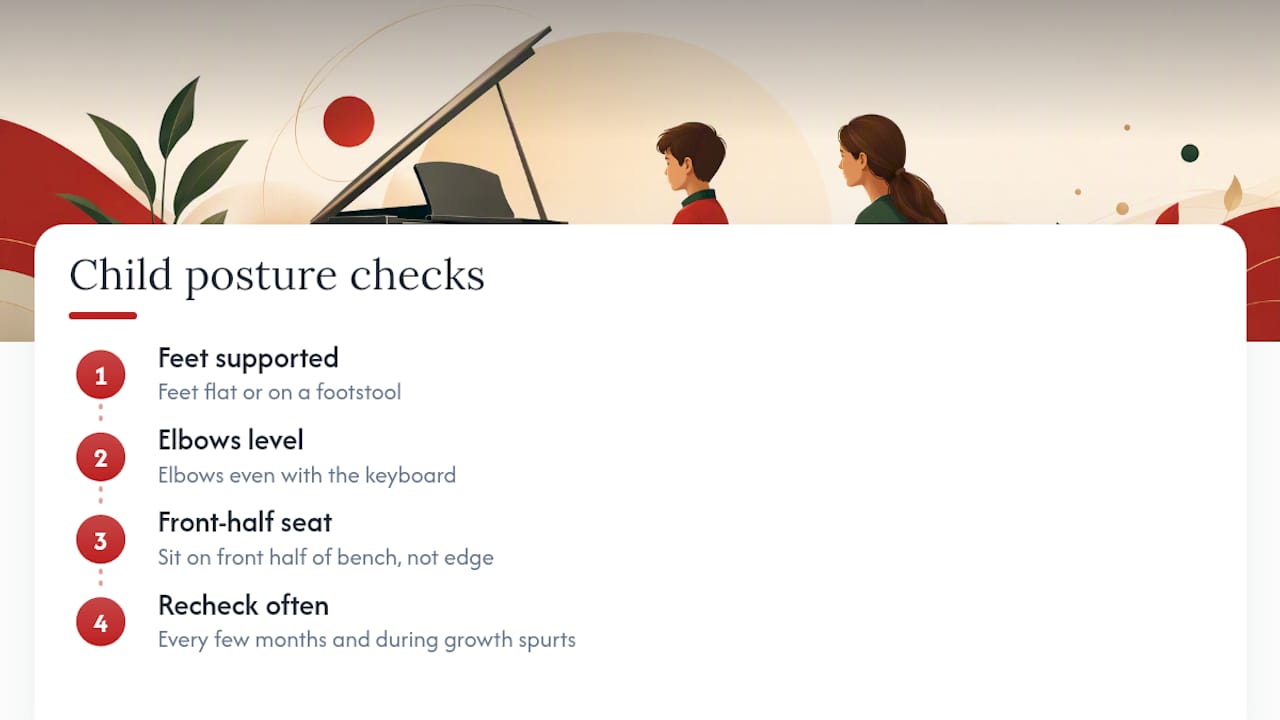
Check a child’s posture the same way you’d check an adult’s: feet flat or resting fully on a footstool, elbows level with the keys, and enough room to sit on the front half of the bench rather than perched right at the back edge. Recheck every few months, especially during growth spurts, and watch for two tells that the height has slipped out of range: the child’s shoulders creeping up toward their ears, or their knees pressing awkwardly against the underside of the keyboard.
Common bench height mistakes and quick fixes
A bench set too low forces the wrists to arch upward and the shoulders to hunch for reach, which tires the forearms fast and flattens tone control. A bench set too high pushes the elbows below the keys, causing the player to press down into the keys with dead weight rather than controlled finger action. Both feel subtly wrong rather than obviously wrong, which is why so many players never notice until a teacher points it out.
Sitting too far back on the bench compounds either problem, since it forces you to lean forward to reach the keys and loses the stable base your sit bones should provide. Soft cushions do similar damage by shifting under you mid-phrase.
Too low: raise the bench or add a firm platform; check elbows again after
Too high: lower the bench or remove excess cushioning
Sitting too far back: shift forward so you’re using the front half of the seat
Persistent pain, numbness, or a technique that keeps breaking down despite correct height: talk to a teacher or a clinician, since bench height alone won’t fix an underlying physical issue
What teachers check before every lesson
Studio practice tends to favour speed over fuss: set the bench, test it, move on. At the start of a lesson, a teacher will typically ask the student to sit, place their hands on the keys, and glance at elbow height before a single note gets played properly. It takes seconds and catches problems before they turn into habits.
Active sitting matters more than most students realise. Weight forward on the sit bones, shoulders down, front half of the bench. That posture alone changes how much control a player has over tone, because a slouched back or a chair-like passive lean steals power from the arm before it ever reaches the keys.
Pro Tip: If you teach or share a piano at home, keep the bench adjustment as the very first step of any session. It sounds trivial, but skipping it is the single most common reason technique drills stop working halfway through a lesson. Dan Piano Studio builds this check into every lesson opening, whether the student is a beginner working through posture fundamentals or an advanced player refining classical technique. Households with more than one student also find that an adjustable bench speeds up transitions between pupils who need different heights.
Where to go for more on posture and technique
For hands-on posture drills, see Dan Piano Studio’s guide to piano posture for beginners, plus advice on helping children build confident practice habits. Players adapting technique for specific situations may also find this guide to one-handed piano playing useful.
Book a piano lesson that starts with the basics right
Reading about bench height gets you most of the way there, but a teacher watching your posture in real time catches things a mirror never will. A good piano studio builds a posture check into the first minutes of every lesson, whether you’re learning classical repertoire, working on jazz improvisation, or preparing for ABRSM and Trinity exams. If a teacher coming to your own piano suits you better, home piano lessons in Central London, Camden, and King’s Cross include that same posture groundwork from the first session. Prefer to learn from wherever you are? Online piano lessons cover the same checks over video, adjustment routine included.
The conventional advice gets the emphasis backwards
Most guides treat bench height as a one-time setup task: measure once, adjust once, forget about it. That’s the wrong frame. Bodies change, benches slip, cushions compress over months of use, and children grow out of a setting within a school term. The number that mattered in September might be wrong by Christmas.
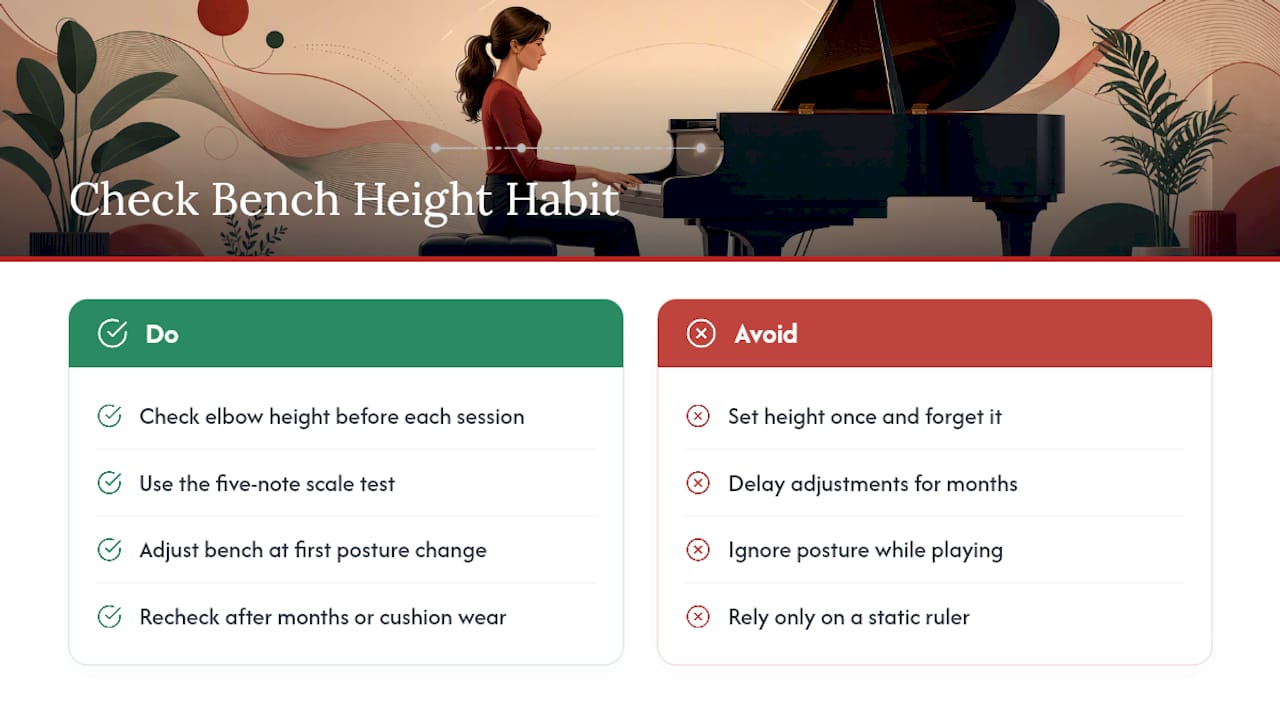
What gets underestimated is how fast a wrong height creates compensating habits that are far harder to unlearn than the original adjustment would have taken to fix. A student who’s played for six months with elbows too low has usually built shoulder tension into their default posture, not just their bench setting. Fixing the bench takes thirty seconds. Un-teaching a year of hunched shoulders takes a lot longer.
If you take one thing from this, make it the habit, not the measurement. Check elbow height before every serious session, not just when you buy new furniture. The five-note scale test costs nothing and catches problems a ruler never will, because posture that looks correct while you’re sitting still often falls apart the moment your hands start moving.
— Dan
Sources
Recommended


Comments