


The circle of fifths piano players actually use

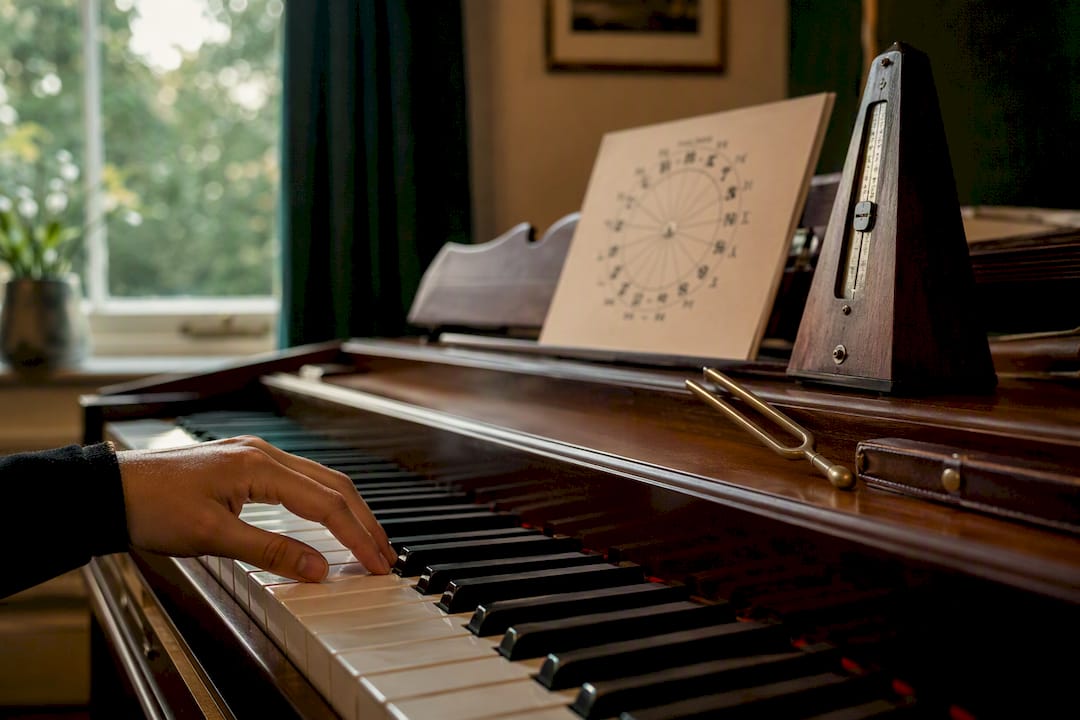
The circle of fifths maps all twelve major keys in a ring, arranged by ascending perfect fifths, so every step clockwise adds one sharp and every step anticlockwise adds one flat. Once that clicks, it changes how you read music, not just how you think about it.
Learn this one shape and you can:
Name any key signature in seconds, sharps or flats
Transpose a piece up or down without guesswork
Build chord progressions that resolve the way your ear expects
Prepare ABRSM and Trinity theory and aural tests with a genuine system, not memorised lists
Improvise with a map instead of trial and error
At Dan Piano Studio, this is one of the first tools we hand every student, because it turns abstract theory into something you can feel under your fingers within a single lesson.
Key Takeaways
The circle of fifths works because it turns key signatures, chord relationships and modulation into one visual, playable system rather than three separate memorisation tasks.
Point | Details |
Direction rule | Clockwise adds sharps, anticlockwise adds flats, one per step around the circle. |
Fast key identification | Use the last sharp plus a semitone, or the second-to-last flat, to name a key instantly. |
Chords follow neighbours | The clockwise neighbour is your V, the anticlockwise neighbour is your IV, explaining most cadences. |
Practise at the keyboard | Drills like left hand harmonic walks build the ear training that paper memorisation cannot. |
Structured lessons accelerate progress | Dan Piano Studio’s home and online lessons pair circle drills with exam prep for ABRSM and Trinity. |
Table of Contents
How to read the circle of fifths explained for piano
Picture a clock face with C major at twelve o’clock. Move clockwise and each key picks up one more sharp: G, then D, then A, and so on. Move anticlockwise and each key picks up one more flat: F, then B flat, then E flat. That clockwise motion is a jump of a perfect fifth upward; anticlockwise is a fourth upward, which is the same as a fifth downward, according to Piano.
The classic mnemonic for the order of sharps is “Father Charles Goes Down And Ends Battle” (F, C, G, D, A, E, B), and flats simply reverse it. These mnemonics still earn their keep, particularly when you are sight-reading and need to know a key signature in under a second, as Dummies’ piano guide points out.
Here is the fast trick for working out a major key from its signature. For sharp keys, go up a semitone from the last sharp written: three sharps ends on G sharp, so the key is A major. For flat keys, the key is named after the second-to-last flat: four flats gives you B flat, E flat, A flat, D flat, and the second-to-last is A flat major. The one exception is F major, which has a single flat and no second-to-last to rely on.
Pro Tip: Write the circle out from memory once a week rather than staring at a printed chart. The act of drawing it, sharp by sharp, cements the order far better than passive reading ever will.
How does the circle explain piano chord progressions?
Every key on the circle has two neighbours, and those neighbours are not random. The key one step clockwise from your tonic is your V (dominant); the key one step anticlockwise is your IV (subdominant). In C major, G sits clockwise and F sits anticlockwise, which is exactly why the I–IV–V progression feels like the backbone of so much Western music. Neighbouring keys on the circle share nearly all their notes, and that overlap is what makes movement between them sound smooth rather than jarring, according to Noisy Clan’s breakdown for pianists.
The famous ii–V–I, sometimes written as the “2–5–1”, is really just three consecutive clockwise steps landing back on home. Play D minor to G major to C major and listen to how each chord pulls harder toward resolution than the last. That pull is the circle doing its job.
Three short progressions worth running through the keys, starting in C major:
I–V–vi–IV (C, G, Am, F): the pattern behind hundreds of pop songs; listen for the lift on the V chord and the gentle fall into vi.
ii–V–I (Dm, G, C): the jazz standard’s backbone; notice how tension builds across the two clockwise steps before resolving.
I–IV–V (C, F, G): the simplest cadence in Western harmony; play it slowly and you will hear the anticlockwise step (IV) sound relaxed against the clockwise step (V) sounding urgent.
Once you can spot these shapes on the circle, reading a lead sheet or a hymn book stops feeling like decoding and starts feeling like recognising a face you already know. For more on how chords stack and function together, our guide to jazz piano chords builds directly on this logic.
Keyboard drills that make the circle stick
Reading about the circle only gets you so far. It needs to live in your hands, and that means short, deliberate keyboard time rather than long theory sessions at a desk, since practising the circle physically at the keyboard builds the muscle memory and listening skills that pure memorisation never quite reaches, per Marbella Piano Lessons’ improvisation guide.
Left hand harmonic walk. Play root notes clockwise around the circle, C, G, D, A, and so on, one per bar, at 60 beats per minute. Once comfortable, add a simple right hand scale or a short improvised phrase over each root.
Chord rotation. Play a triad on every step of the circle and say its name out loud before you play the next one. Aim for five full laps without hesitating on the naming.
Transposition drill. Take a two-bar phrase in C major and move it to G major (one clockwise step), then to D major (two steps). Notice which fingers and hand shapes stay identical and which shift.
Practise scales in the target key immediately before each drill; moving from a scale into a circle exercise makes the leap from theory to playable phrase far less abrupt, a sequence Marbella’s guide recommends for adult learners specifically. Ten minutes a day beats an hour once a week. Increase difficulty by adding seventh chords once triads feel automatic, and resist the urge to rush past keys with more sharps or flats. Those are exactly the keys that expose sloppy fingering.
Pro Tip: If a key trips you up, isolate it. Play just that one triad, slowly, twenty times in a row before rejoining the full circle lap.
Using the circle for sight-reading and exam preparation
Spotting a key signature fast is half the battle in an ABRSM or Trinity exam room, and the circle turns that into a reflex rather than a guessing game.
Count the sharps or flats, apply the last-sharp or second-to-last-flat rule, and you have named the key before the examiner finishes explaining the piece.
Once you know the key, you can predict likely cadences: expect the dominant (one step clockwise) and subdominant (one step anticlockwise) to appear often, which helps with aural tests and unfamiliar sight-reading passages.
For transposition questions, treat the circle as a route planner. Move to the neighbouring key first to check your ear, then extend to keys two or three steps away once that feels secure.
Structure short practice sessions around one unfamiliar key per week, working outward from keys you already know well.
Grade exams increasingly test this kind of applied understanding rather than rote recall, so treating the circle as a working tool, not a poster on the wall, pays off directly in the exam room.
Where did the circle of fifths come from?
The circle of fifths did not arrive as a single invention. It grew out of centuries of tuning experiments and the practical need to organise an expanding tonal system. Theorists working with just intonation and later well-tempered tuning noticed that stacking perfect fifths eventually cycles back close to the starting pitch, and that observation gradually became the visual and conceptual tool pianists use today.
The concept is often associated with early eighteenth century theoretical writing, a period when composers and theorists were actively wrestling with how to make all twelve keys usable on a single fixed-pitch instrument. Before well-tempered tuning became standard, certain keys sounded noticeably better in tune than others, because pure acoustic fifths do not divide evenly into an octave. Tempering, adjusting each fifth very slightly, spread that imperfection evenly across all twelve keys rather than concentrating it in a few unusable ones.
Johann Sebastian Bach’s The Well-Tempered Clavier is the piece most commonly cited as proof of concept: two preludes and fugues in every major and minor key, demonstrating that a single tuning system could make the whole circle playable. That collection remains one of the clearest historical arguments for why the circle exists at all, not as decoration, but as a solution to a real tuning problem keyboard players had lived with for generations.
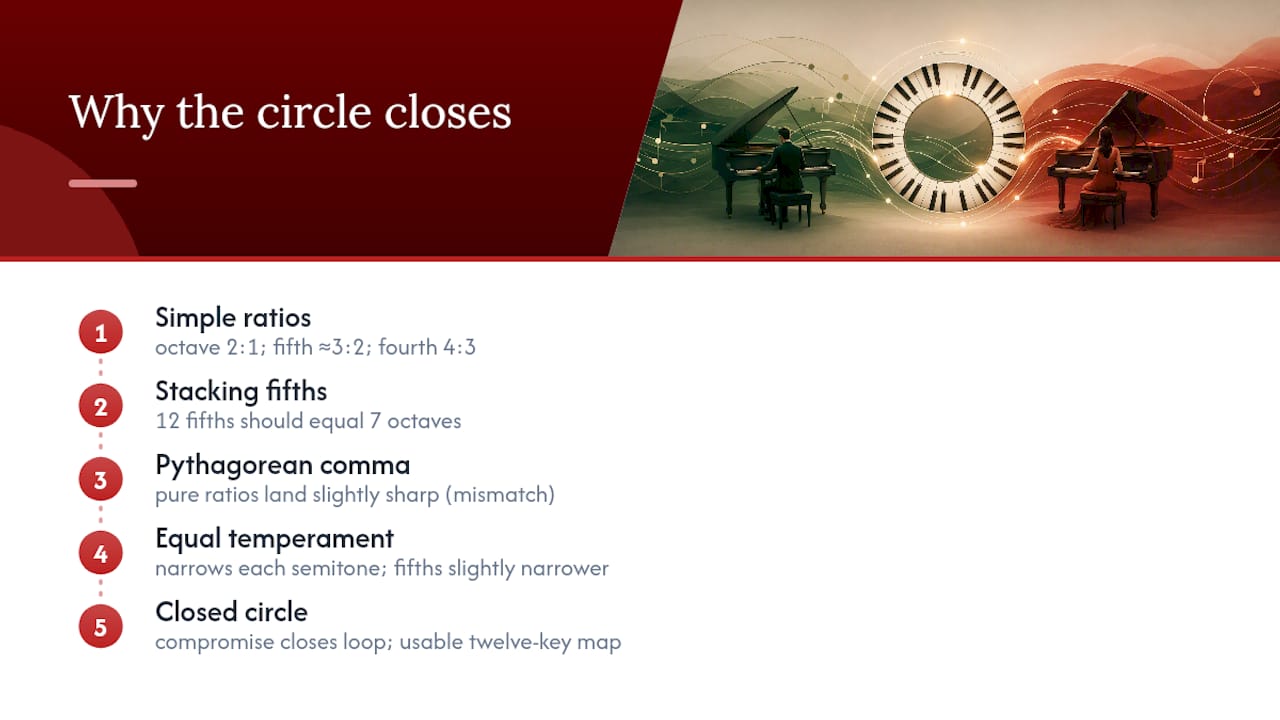
Why the circle of fifths works: the acoustics behind it
The circle exists because of how sound itself behaves, not because a theorist decided keys should be tidy. A perfect fifth is the interval you get from a frequency ratio close to 3:2, one of the simplest and most consonant ratios in acoustics after the octave (2:1) and the fifth’s near-neighbour, the fourth (4:3).
Stack twelve perfect fifths on top of each other and you should, in theory, land back on the note you started from, seven octaves higher. In practice, using pure mathematical ratios, you land slightly sharp of that starting pitch. Musicians call this mismatch the Pythagorean comma, and it is the reason equal temperament exists at all: divide the octave into twelve mathematically identical semitones, and every fifth becomes very slightly narrower than a pure acoustic fifth, but close enough that most ears do not notice while playing.
That tiny compromise is what makes the circle close into a perfect loop rather than spiralling forever outward. It is also why a piano tuned in equal temperament sounds fractionally different from a string quartet playing the same chord in pure just intonation, a difference some listeners with trained ears can pick out immediately. For pianists, the practical upshot is straightforward: the circle works as a closed twelve-key system specifically because equal temperament smooths over that mathematical gap, giving you a genuinely usable map rather than an infinite, unrepeating staircase of fifths.
Different ways to draw and visualise the circle
The bare circle, just twelve major key names in a ring, is the version most people meet first, but it is not the most useful one for actual practice. Most serious study charts add the relative minor for each key on an inner ring, directly opposite or nested within its major counterpart, which turns the diagram into two circles in one and shows at a glance which minor key shares a signature with which major key.
Some charts extend further outward, adding a third ring of diminished or enharmonic keys at the bottom of the circle, around F sharp and G flat major, where sharp and flat spellings overlap. That region, sometimes called the “theoretical keys” zone, matters more for composition and advanced modulation than for everyday practice, but it is worth knowing it exists so an unfamiliar chart does not throw you.
Colour-coded versions are common in teaching studios: warm colours for sharp keys, cool colours for flat keys, with C major sitting neutral at the top. Interactive versions, including the kind found on piano.org’s guide, let you click through each key and hear the resulting chord, which suits students who learn better by ear than by staring at static print. Whichever version you use, the underlying shape never changes: what varies is how much extra information is layered onto it, and a cluttered chart can obscure the basic clockwise and anticlockwise logic just as easily as it clarifies it.
Common mistakes when learning the circle of fifths
The most frequent error is treating the circle as something to memorise on paper rather than something to play. A student who can recite “G major has one sharp” instantly but cannot find G major’s dominant chord at the keyboard has memorised a fact without absorbing the tool.
Confusing clockwise and anticlockwise direction trips up almost everyone at first, particularly because some diagrams orient sharps to the left and others to the right. Fix a single mental anchor, sharps go clockwise, and stick with it rather than relearning the direction every time you see a differently drawn chart.
Another common trap is assuming every progression must move clockwise. Plenty of excellent music deliberately moves anticlockwise or jumps across the circle entirely; the circle explains why certain motions sound smooth or resolved, it does not dictate that all music must obey that logic.
Students also frequently mix up relative minor with parallel minor. A minor is the relative minor of C major, sharing its key signature, while C minor is the parallel minor of C major, sharing its tonic note but not its signature. These are genuinely different concepts and conflating them causes confusion later when studying modulation. Finally, many learners stop at major keys and never map the minor circle properly, even though minor key signatures follow the identical clockwise and anticlockwise logic once you know each minor’s relative major.
Using the circle for modulation between distant keys
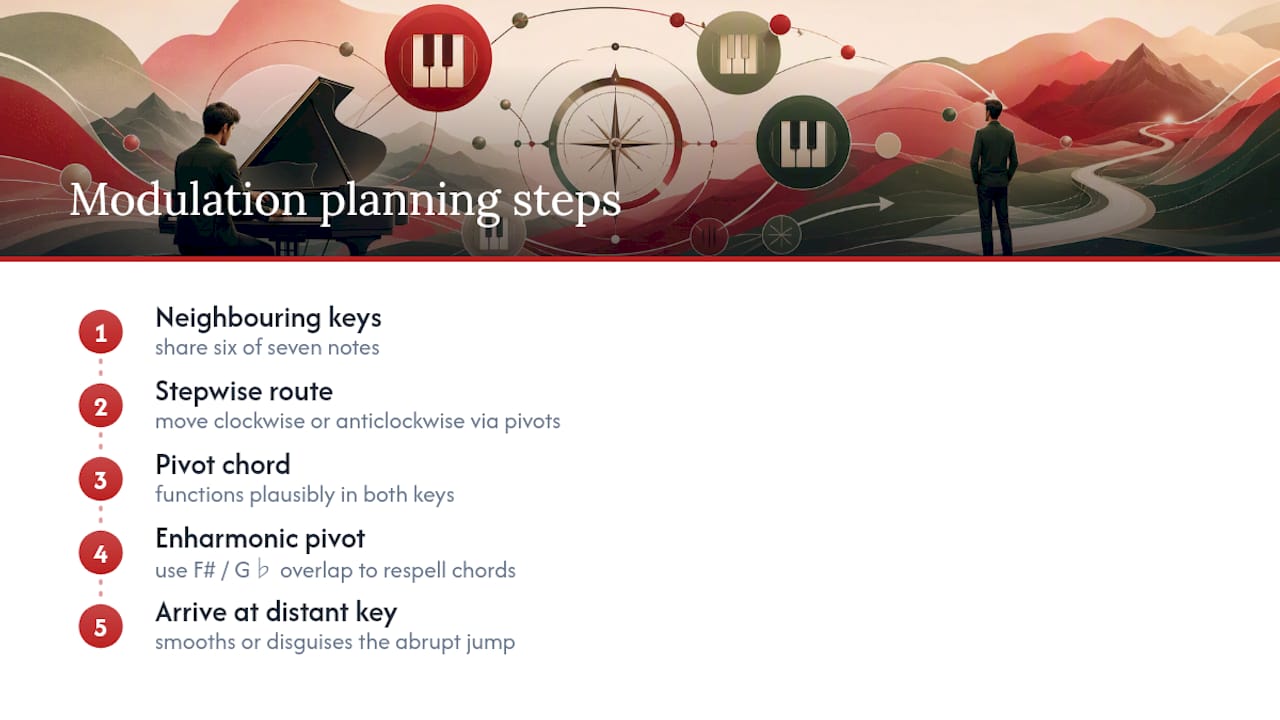
Modulating to a neighbouring key, moving from C major to G major, barely disturbs the ear because the two keys share six of their seven notes. Modulating between distant keys, say from C major to F sharp major, sitting on the opposite side of the circle, is a different challenge entirely, since the two keys share almost no notes at all.
The circle becomes genuinely useful here because it lets you plan a route rather than lurching straight there. Composers often modulate stepwise, treating each clockwise or anticlockwise move as a stepping stone, briefly touching a pivot key that shares elements of both the starting and destination keys before arriving at the distant target. A pivot chord, one that functions plausibly in both keys, smooths the transition and disguises what would otherwise sound like an abrupt jump.
Enharmonic modulation exploits the circle’s closure point directly, that overlap zone around F sharp and G flat major where sharp spellings and flat spellings describe the same physical keys. Reinterpreting a chord’s spelling at that junction lets a composer pivot into remote harmonic territory that would otherwise take several steps to reach. This is advanced material, more relevant to composition and higher grade theory than to a first year of lessons, but understanding it changes how you listen to music that seems to shift mood unexpectedly. That shift is rarely random; it is usually the circle being used deliberately.
Circle of fifths in famous piano repertoire
Bach’s The Well-Tempered Clavier remains the definitive circle-of-fifths piece, working through all twelve major and twelve minor keys across its two books, a direct demonstration that the full circle was playable and musically viable under equal temperament.
Chopin’s Prelude in C minor, Op. 28 No. 20, and several other preludes in that same set are arranged, like Bach’s collection, around the full sweep of major and minor keys, following circle-of-fifths logic in their ordering rather than an arbitrary sequence.
Pachelbel’s Canon in D, while not written for solo piano originally, is a staple of piano arrangement lessons and offers one of the clearest audible examples of a descending circle-of-fifths bass line, moving D, A, B minor, F sharp minor, G, D, G, A, in a pattern so recognisable it has been borrowed by pop songwriters for decades. Practising that bass line alone at the keyboard is a genuinely effective way to feel the circle’s logic in your fingers rather than just seeing it on a page.
How Dan teaches the circle of fifths at the keyboard
A typical lesson runs theory first, five minutes at the keyboard sketching the circle, then straight into a drill: chord rotation or a transposition exercise, before finally applying it inside a piece the student already half knows.
Children respond best to short, game-like repetitions, naming chords as fast as possible. Adult beginners usually want the acoustic reasoning explained alongside the drill, while exam candidates need the circle tied directly to their ABRSM or Trinity syllabus keys. Our piano theory basics post and improvisation guides on the blog give students something to revisit between lessons, so progress compounds rather than resetting every week.
Learn the circle of fifths properly with lessons in London or online
Reading about the circle gets you halfway there; the rest happens with someone listening to your hands and correcting the habit before it sets. Dan Piano Studio runs both formats built for exactly this kind of applied theory work: home lessons across Central London, Camden and King’s Cross, and online lessons for anyone who prefers to practise from their own piano.
A first lesson focused on harmony typically starts by mapping the circle against whatever piece you are already working on, then moves into a short chord rotation drill so you leave with something you can practise immediately, not just notes to reread later. Beginners usually walk away naming key signatures on sight within a few sessions; more advanced students use the same lesson structure to tackle transposition and exam-specific aural questions for ABRSM and Trinity. If you are practising alone at home already, pairing that with structured beginner piano exercises keeps the two approaches working together rather than at cross purposes.
Book a home piano lesson if you want in-person tuition in Central London, Camden or King’s Cross, or start an online piano lesson if remote learning suits your schedule better. Either way, the next step is simply getting a lesson in the diary.
Frequently asked questions
What is the circle of fifths on piano used for? It is used to read key signatures quickly, plan transpositions, understand why chord progressions like I–IV–V sound resolved, and structure practice for exams including ABRSM and Trinity.
How do you memorise the circle of fifths for piano? Draw it from memory weekly rather than reading a printed chart, and pair that with keyboard drills such as chord rotation, since playing the circle embeds it far better than viewing it.
Does the circle of fifths include minor keys? Yes. Every major key has a relative minor sharing its exact key signature, usually shown on an inner ring of the chart, three semitones below the major tonic.
Why does the circle move by fifths rather than another interval? A perfect fifth is one of the simplest, most consonant intervals after the octave, and stacking fifths happens to cycle through all twelve pitches before returning close to the start, which is why the shape closes into a circle under equal temperament.
Can beginners use the circle of fifths for improvisation? Yes, and it is often easier for beginners than advanced harmony theory, because moving one step at a time around the circle naturally produces smooth-sounding chord changes without needing to know why in advance.
Sources
For deeper explanation of the clockwise and anticlockwise logic, piano.org’s interactive guide lets you click through each key. Dummies’ piano guide covers the sharp and flat naming rules in more depth, while Marbella Piano Lessons’ improvisation guide expands on keyboard drills for playing by ear.
On the Dan Piano Studio blog, our guides to jazz chords, the blues scale, and improvisation for beginners all build directly on circle-of-fifths logic.
Recommended


Comments