


Returning to the piano as an adult: a practical plan

Yes, adults can return to the piano and make real, steady progress, often faster than they expect. The path back is not about starting from zero. It is about reawakening skills that are still in there, somewhere between your fingers and your memory.
Do three things in the next 72 hours. Book a short trial lesson with a qualified teacher, perhaps through a directory like EPTA-UK. Pick one piece that actually means something to you, not a grade-book default. Then set a daily habit of just 10 to 20 minutes, no exceptions, no guilt if it is imperfect.
Here is what tends to happen next:
Week one: basic muscle memory starts waking up, faster than most people believe possible.
6 to 12 weeks: steady, visible progress on chosen repertoire.
6 to 12 months: many adult returners are close to, or even past, their previous standard, according to Pianist Magazine.
Organisations like ABRSM and studios such as Danpianostudio exist precisely to support this stage of the journey, whether you want structured exams or simply want to play well again.
Key Takeaways
Consistent short practice, meaningful repertoire, and realistic timelines determine whether an adult returner rebuilds their skills successfully within months, not years.
Point | Details |
Start small and immediately | Book a trial lesson, choose one meaningful piece, and practise 10 to 20 minutes daily from day one. |
Expect a 6 to 12 month timeline | Many adults return to their previous standard within this window with consistent practice. |
Focus 80% of effort on 20% of material | Isolate the hardest bars and transitions rather than replaying whole pieces repeatedly. |
Choose repertoire before technique | A meaningful, manageable piece rebuilds skill faster than starting again from a method book. |
Protect your body first | Warm up off the keyboard and check bench height before blaming technique for aches or pain. |
Table of Contents
How returning to piano as an adult differs from starting as a child
Adults come back to the instrument with things a ten-year-old never had: genuine motivation, the patience to sit with a difficult passage, and the freedom to choose music that actually interests them. You are not being sent to lessons by a parent. You are choosing this, which changes how practice feels almost immediately.
There are trade-offs, though. Adult hands and shoulders often carry more tension than a child’s, joints can feel stiffer at the keyboard, and the first few sessions back can leave you surprised at how quickly stamina fades in the forearms. None of this is permanent. It is simply the cost of a body that has spent years doing other things.
The bigger obstacle is usually mental, not physical. Melanie Spanswick describes what she calls the comparison trap, where adult returners judge their current playing against a memory of themselves at their technical peak, often as a teenager with far more free practice time than any working adult has now.
Adult learners risk measuring today’s playing against a teenage best, when the honest comparison should be with where they stood a month ago, not fifteen years ago.
That comparison is almost never fair, and it is the single biggest reason adults quit within the first few months.
Pro Tip: Write down what you can play today, then check back in four weeks. Comparing yourself to your past self, not your teenage self, is the only measurement that keeps you motivated.
How do you set realistic goals when returning to piano?
The goal you pick shapes everything about how you practise, so choose deliberately rather than defaulting to “get better,” which is too vague to act on.
Play a handful of pieces you love. Focus practice on repertoire, phrasing and musicality rather than exercises.
Finish a piece from your childhood repertoire. Focus on the sections that gave you trouble originally, working them in isolation.
Pass an ABRSM or Trinity College London grade. Structure practice around technical requirements, scales and sight-reading.
Perform for friends or family. Prioritise performance practice, playing through without stopping, over perfectionism.
Learn chords and improvisation. Shift focus toward aural skills and harmonic understanding rather than fixed notation.
Whichever you choose, break it into checkpoints. At 4 weeks, you should have one short passage that feels genuinely comfortable. At 12 weeks, aim for a full short piece, or a full grade’s worth of scales, played without hesitation. At 24 weeks, most returners can hold a small programme of two or three pieces, ready to play for someone else.
For adults short on time, the micro-goal works best: 15 minutes daily, split between a two-minute warm-up and ten focused minutes on a single phrase that is not yet reliable. Pianist Magazine recommends aiming for five practice days a week rather than daily perfection, which leaves room for rest without losing momentum.
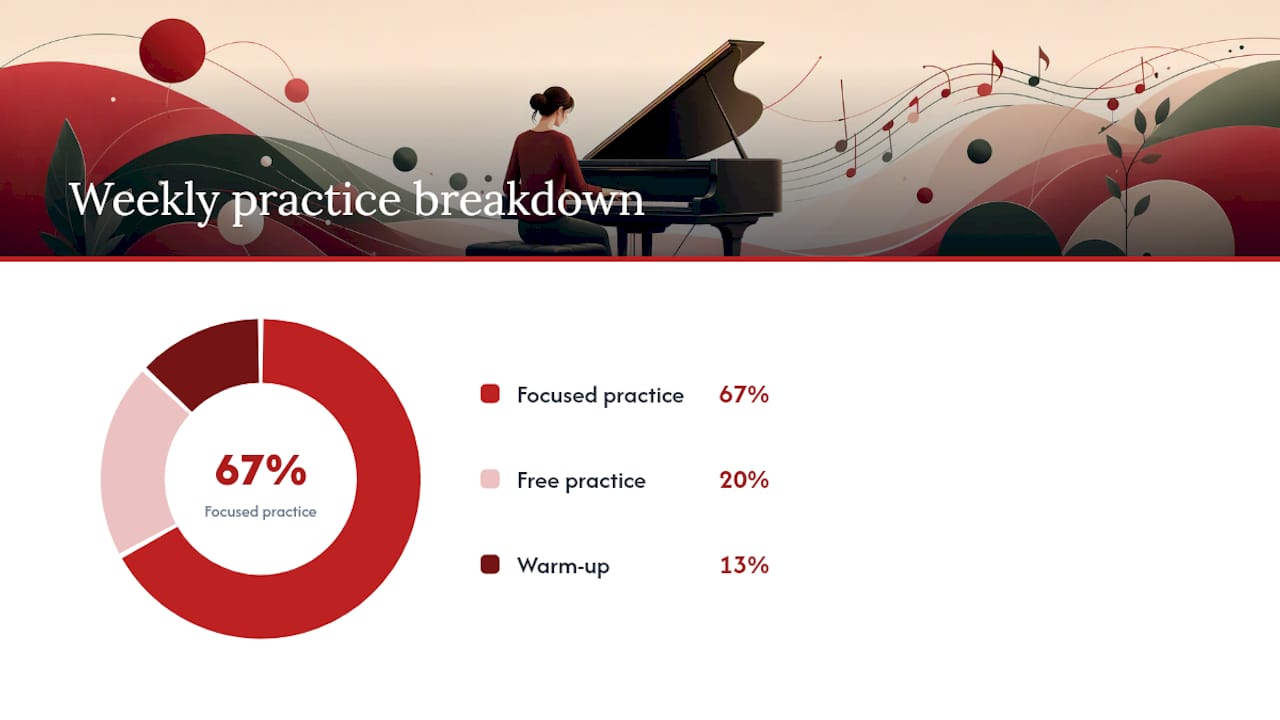
What does a realistic weekly practice plan look like?
Adult returners rarely need long sessions.
A single 20-minute session might break down like this:
Warm-up (3 minutes): slow five-finger patterns or simple scales, hands separately.
Technique focus (5 minutes): one specific problem, such as a tricky chord change or a scale passage.
Repertoire chunk (10 minutes): the hardest four bars of your chosen piece, isolated and repeated slowly.
Cool-down and listen-back (2 minutes): play the section at tempo once, then stop.
If your week allows only 15 to 30 minutes a day, protect the technique-and-chunk block above all else. If you have closer to an hour, extend the repertoire chunk to 25 minutes and add a second passage, plus five minutes of sight-reading using a piece you have never seen before.
The bars that matter most are usually the transitions: where one hand position shifts to another, where a phrase changes direction, or where both hands need to coordinate a new pattern. Isolate those bars, play them hands separately at a slow, steady tempo, then bring the hands together only once each hand is confident alone.
Set the metronome 20% slower than your target tempo and stay there until the passage is genuinely relaxed.
Increase tempo in small steps, roughly 4 to 6 beats per minute at a time, never more.
Only move to the next increment once you can play the passage three times cleanly in a row.
Resist the urge to jump straight to performance speed. It rebuilds bad habits faster than it builds good ones.
Pro Tip: If a passage falls apart at a certain speed, that speed is your new target, not your final one. Sit there for two or three sessions before pushing further.
The Piano Academy of Ireland points out that muscle memory and sight-reading often return faster than adults expect, sometimes within days, provided practice stays consistent rather than occasional. For a deeper breakdown of daily structuring, how to practise piano effectively covers scheduling in more detail.
Should you buy a digital piano or an acoustic one?
This is the first practical decision most returners face, and there is no universally correct answer, only trade-offs worth understanding.
An 88-key weighted digital piano is quiet, needs no tuning, and fits into a flat without upsetting the neighbours. What it usually cannot replicate is the subtlety of touch an acoustic instrument offers at advanced technical levels, a point Pianist Magazine’s buyer guide makes clearly when comparing the two for serious players.
An acoustic upright, by contrast, gives you real dynamic range and a more natural feel under the fingers, but it needs space, occasional tuning, and a more considered budget.
Entry-level digital piano: roughly £300 to £600, suitable for daily practice and most grade work.
Mid-range digital piano: roughly £700 to £1,500, often with better weighted action and speakers.
Used acoustic upright: roughly £500 to £2,000 depending on condition and brand, plus tuning costs.
New acoustic upright: typically £3,000 upward from a specialist dealer.
Try before you buy wherever possible. Gear4Music, a major UK retailer, stocks a wide range of digital instruments and often allows in-store or showroom trials, while local piano dealers and hire schemes let you test an acoustic without committing to a full purchase. A used acoustic should always be checked or serviced by a technician before you buy, since hidden tuning or action problems are expensive to fix later. If budget or space is tight, a good mid-range digital is a sensible starting point, with an upgrade to acoustic once you know you are back for good.
Where can you find a piano teacher or course in England?
A trial lesson tells you more in thirty minutes than any amount of research online, but it helps to know where to look first. EPTA-UK, the UK arm of the European Piano Teachers Association, maintains a teacher directory built specifically for this. The Independent Society of Musicians offers professional guidance and can help verify a teacher’s credentials. If exams matter to you, ABRSM and Trinity College London both publish syllabus information that most teachers structure lessons around.
Local, in-person lessons give you direct feedback on posture and hand position that is hard to replicate on a screen, plus access to a proper acoustic instrument during the lesson itself. Online lessons trade some of that immediacy for flexibility, useful if your schedule is unpredictable or you live somewhere with fewer local teachers.
Before committing, ask a prospective teacher:
How do you structure a typical lesson for a returning adult?
Can I choose my own repertoire, or is it prescribed?
How do you measure progress between lessons?
Do you have experience preparing adult students for ABRSM or Trinity exams?
What happens if I miss a lesson or need to reschedule?
How much practice do you expect between sessions?
Can I hear you play, or see examples of past student progress?
Do you offer trial lessons before a longer commitment?
How do you handle technical problems like tension or old bad habits?
What is your approach if I just want to play for enjoyment, not exams?
Danpianostudio, based in Central London with lessons available in Camden, King’s Cross and online, is built specifically around this kind of returning adult student, offering tailored classical, jazz and improvisation teaching alongside exam preparation for those who want it. For more on what tailored adult tuition looks like in practice, see private piano lessons for adults that work.
How do you protect your hands, wrists and shoulders when restarting?
Adult bodies need a bit more preparation than a child’s does, and skipping this step is the fastest route to frustrating aches that stall progress.
Start with the bench. Sit so your forearms are roughly level with the keys, shoulders relaxed and down, not hunched toward your ears. Feet flat on the floor for stability.
Before playing, spend two minutes on simple preparation: gentle wrist circles, finger stretches pulling each finger back softly, and a slow shoulder roll to release tension built up from a desk job. Interlude’s guidance on returning to the piano notes that off-keyboard stretches, in the style of gentle yoga or Pilates, measurably reduce injury risk and make short sessions more productive.
Stop immediately if you feel sharp pain, numbness or tingling, and see a GP or physiotherapist if it persists beyond a day or two of rest.
Dull muscular fatigue after a session is normal; sharp joint pain is not.
A five-minute yoga-style stretch routine before practice pays for itself many times over in comfort.
Pro Tip: If your wrists ache after every session, check your bench height before anything else. It is the most common, and most overlooked, cause of tension.
How should you rebuild repertoire and technique together?
Do not start again from a beginner’s method book. Living Pianos makes the case that a repertoire-first approach reconnects your musical instincts with rebuilding technique far more effectively than isolated drills ever could.
Pick a piece that is meaningful, manageable at your current level, and contains at least one genuine technical challenge worth solving. Then work it properly:
Study the score away from the piano first, marking difficult bars before you even sit down.
Break it into two to four bar chunks and work each hand separately before combining them.
Practise slowly, with real musical shaping, rather than mechanically at speed.
Use five-minute technical add-ons, like a relevant scale or arpeggio pattern, to support the piece’s specific demands.
Set weekly targets for sections, not whole pieces. “This phrase, cleanly, by Sunday” beats “the whole piece by next month.”
A classical repertoire guide can help with choosing pieces that build technique progressively rather than randomly.
How long does it realistically take to get back to your old standard?
Progress arrives in three recognisable stages, and knowing them in advance stops you from panicking during the slow bits.
2 to 6 weeks: a daily habit takes hold, and one or two short sections start to feel genuinely playable again.
3 months: several pieces, or larger sections of harder ones, become fluent rather than shaky.
6 to 12 months: many returners are back near their previous standard, sometimes past it, according to Pianist Magazine.
To track this without obsessing over perfection, record yourself monthly, set small metronome speed targets, and ask a teacher for honest feedback rather than relying on your own ear alone. If you can play a passage through without tension or hesitation, that is real progress, whether or not it sounds concert-ready.
Fifteen minutes a day and sixty minutes a day both work, but they land you on different points of this timeline. Consistency at 15 minutes beats sporadic hour-long sessions almost every time.
What actually stops adults getting back into piano, and how do you fix it?
Time is the obstacle everyone names first, but it is rarely the real one. The deeper barriers are shame, plateaus and physical discomfort, and each has a specific fix rather than a vague “try harder.”
Lack of time: block a fixed slot in your calendar, even ten minutes, and treat it as non-negotiable rather than optional.
Shame or comparison: deliberately choose repertoire that fits your current level, not your teenage peak, as Pianist Magazine advises when discussing realistic goal-setting.
Plateaus: introduce a small performance, even just playing for one person, to break the monotony of solo practice.
Physical discomfort: build in short breaks every 15 minutes rather than pushing through stiffness.
Pro Tip: Keep a one-line practice journal, or record a quick voice memo after each session. Reading back three weeks of “small win” notes does more for motivation than any amount of willpower.
Swap outcome goals like “sound as good as I did at eighteen” for process goals like “practise five days this week.” Consistency, not intensity, is what actually rebuilds a skill this complex.
What resources should adult returners in the UK know about?
A short, trustworthy list beats an overwhelming one. Start here:
EPTA-UK: teacher directory and professional standards body for piano tuition across the UK.
ISM: membership and guidance for musicians, useful for verifying credentials.
Gear4Music: national retailer for digital pianos, keyboards and accessories, with trial options in some locations.
Recording apps and a basic metronome app cover most technical needs; a solid tutor book recommended by your teacher beats a random online download.
For structured, adult-focused lesson content, adult beginner piano and piano technique exercises that really help are worth bookmarking alongside these organisations.
Ready to make the return stick?
Reading about practice plans only gets you so far. What moves the needle is a structured lesson with someone who can see exactly where your technique needs attention, something a book or app cannot replicate. Danpianostudio offers tailored lessons for returning adults across Central London, Camden, King’s Cross, and online, covering classical and jazz piano, improvisation, music theory, and ABRSM or Trinity exam preparation for those who want a formal target.
If you are weighing up formats, home piano lessons suit those who want in-person teaching without travelling, while online piano lessons fit a busier or less predictable schedule. Either way, a single trial lesson tells you more about your current level, and what to focus on next, than months of guessing alone.
An editorial view on returning to the piano as an adult
The advice most returners receive is technically sound and practically useless: “practise more consistently.” True, but empty. What actually determines whether someone sticks with this is whether the first piece they choose means something to them, not whether it is graded correctly for their level.
Conventional teaching wisdom still leans toward method books and scales-first structure, inherited wholesale from how children are taught. Adults do not need that scaffolding nearly as much. They need a reason to sit down each day, and a meaningful piece of music does more for consistency than any exercise book.
If you take one thing from this guide, prioritise repertoire selection over everything else, including instrument choice, teacher choice, and practice-plan complexity. Get the music right first. Everything else, technique, tempo, tension, sorts itself out far more easily once you actually want to play.
Frequently asked questions
Is it too late to learn piano as an adult? No. Adults regularly reach a high standard, and prior experience means returning is almost always faster than starting from scratch.
How many hours a week should an adult beginner practise? Fifteen to thirty minutes daily, five days a week, tends to produce steadier results than one long weekend session, according to Pianist Magazine.
Do I need an acoustic piano to get back into playing seriously? Not necessarily. A weighted 88-key digital piano suits most returners well; an acoustic becomes more valuable at advanced technical levels.
How long before I can play like I used to? Many returners are close to their previous standard within 6 to 12 months of consistent practice, though this varies with how much you played before and how often you practise now.
Sources
Recommended


Comments