


3 Studio Tested Music Lesson Cancellation Policy Templates for Studios


Most piano and music studios ask for at least 24 hours’ notice to cancel or move a lesson without charge; anything shorter, or a straight no-show, is usually billed at the full lesson rate. Notice given in time typically earns a make-up lesson or a credit rather than a refund. Refunds themselves are rare for missed single lessons, but they do apply when the teacher is the one cancelling. A published policy, prepayment through a booking portal, and automated reminders keep most of these situations from turning into arguments.
TL;DR:
Studios prefer at least 24 hours’ notice for cancellations to avoid full-charge fees, with deadlines varying between 24 hours and 7 days depending on the policy.
Refunds are rare and usually reserved for teacher cancellations, while credits and make-up lessons are prioritized for student absences within set windows.
Clear documentation and booking portal communication significantly reduce disputes, with policies including active agreement and timestamped notices.
Short notice cancellations favor families, whereas longer windows protect the teacher’s schedule for fixed-term and block-booked lessons.
Typical policies should specify notice periods, fee structures, make-up options, and withdrawal procedures to ensure fairness and consistency in enforcement.
Table of Contents
Quick checklist: what every music lesson cancellation policy should state
A policy that actually works on paper covers six things, in plain language, before a single lesson gets booked.
Notice window. State the exact cut off, whether that’s 24 hours for weekly lessons or 7 days for a term of group classes.
The fee for late cancellations or no-shows. Say whether it’s the full lesson rate, a partial charge, or loss of a credit.
How make-ups, credits and refunds work, including any expiry date on unused credit.
What happens when the teacher cancels. A substitute, an online session, or a straight refund.
Accepted notice channels. A booking portal with a timestamp beats a text message nobody can prove was sent.
Payment terms. Whether lessons are prepaid, billed monthly, or sold as a block, since this changes what “cancelling” even means.
Miss any one of these and you’re relying on goodwill to settle disputes, which works fine until it doesn’t.
Why notice periods and fees vary so much between studios
A 24-hour rule and a 7-day rule solve two different problems, and studios pick one depending on how much financial risk they’re willing to carry.
Shorter windows favour families. Life happens, illness strikes overnight, and a parent juggling three children’s schedules cannot always give two days’ warning. But every short-notice cancellation a teacher accepts without charge is unpaid time they can’t fill with another student. Musicteachers reflects this tension directly, noting that many networks now automatically cancel a lesson if payment hasn’t landed 24 hours before it starts, which forces the notice question and the payment question to resolve at the same time.
Longer windows protect the teacher’s diary, particularly for exam preparation runs or block-booked terms where a missed slot is genuinely hard to refill.
Fee structures generally fall into one of these patterns:
Full lesson charge for anything inside the notice window, no exceptions.
Partial charge, often around 50%, as a middle ground for families who cancel just short of the deadline.
Loss of one prepaid lesson from a package, with the rest of the block untouched.
Credit retained, but only redeemable within a set period.
Block bookings and monthly billing tend to tighten these rules further, since a missed lesson inside a paid month is harder to treat as a one off.
Pro Tip: Write the fee as a number, not a percentage of “the lesson rate” — parents read “£35” faster than they do a formula, and it removes any argument about which rate applies.
Make-up lessons, refunds and credit rules that actually work
Make-ups exist because a strict “no refund, no exception” line usually costs a studio more in lost trust than it saves in fees. The common approaches are:
Same teacher, rescheduled slot, the gold standard where diaries allow it.
A substitute teacher, useful for one-off gaps rather than a whole term.
A group make-up session, common where several students missed similar weeks.
An online or video lesson, which fills the gap without anyone needing to travel.
Refunds are the exception, not the rule, for lessons a student misses. Most studios reserve cash refunds for situations where the teacher cancels, not the student. Credit is the usual middle ground: the student keeps the value of the lesson but redeems it later, inside a defined window.
That window matters more than it sounds. Policy language from Vivid School of Music shows the pattern that credits from student cancellations typically expire within a set period, while credit from a teacher-cancelled lesson often carries no expiry as long as the student stays enrolled. That asymmetry is fair, reflecting who caused the cancellation.
Package terms should say plainly whether unused lessons transfer between siblings, whether they expire at term end, and whether a partially used block is refundable if a family withdraws.
Handling no-shows and late arrivals without losing goodwill
A no-show with zero notice is usually billed as a full lesson. Some studios allow a single tolerant cancellation per term that doesn’t count against the student.
Late arrivals typically have policies such as shortening the lesson without refund for lost time or charging the full lesson rate since the slot remains blocked.
Reducing no-shows by using reminders or deposits is more effective than enforcing penalties after the fact.
What happens when the teacher has to cancel
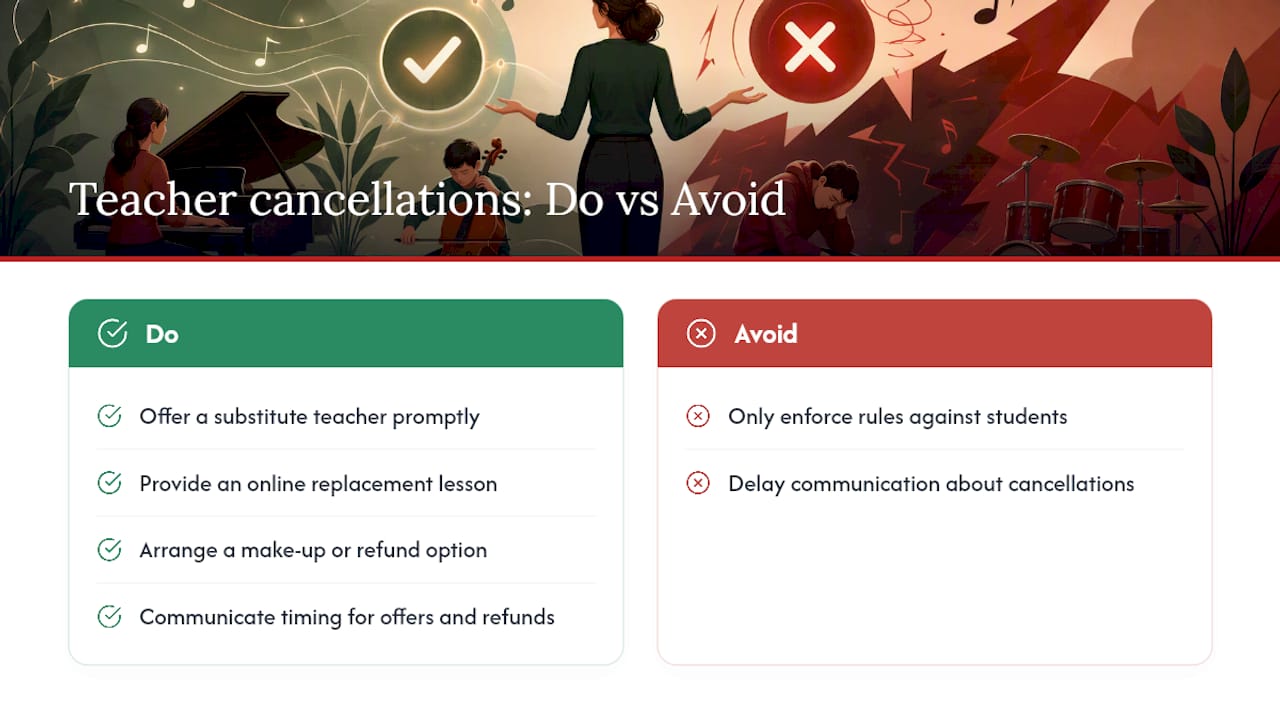
The obligation runs both ways, and studios that only enforce rules against students lose credibility fast. When a teacher cancels, the standard remedies include offering a substitute teacher, providing an online lesson as a replacement, or arranging a make-up or refund.
Studios should communicate clearly how quickly these options will be offered and refunds processed. For unexpected closures like weather, moving lessons online and early communication is best practice.
How to communicate and enforce the policy without friction
The policy only works if people actually read it before they need it, not after.
Publish it in three places: the website, the booking confirmation email, and any welcome pack a new student receives.
Require active agreement at booking, a checkbox or signature, rather than a link buried in a footer.
Route cancellations through one channel, ideally a booking portal, so every notice carries a timestamp nobody can dispute later.
Send a reminder 24 to 48 hours ahead, timed to match the notice window itself.
Keep the enforcement language polite but consistent. “As outlined in our booking terms, this lesson is charged at the full rate” reads firmer than an apologetic explanation.
Teacher networks such as The Curious Piano Teachers recommend exactly this: routing cancellations through a time-stamped system rather than informal messages, which removes the “I texted you” versus “I never got it” argument entirely. Professional guidance from the Incorporated Society of Musicians makes a similar point about written terms generally, that clarity up front prevents most disputes before they start.
Discretion still has a place. A genuine emergency, bereavement, or hospital admission is not the same as a forgotten diary entry, and most studios waive the fee in those cases. Just write down when you did it and why, so the exception doesn’t quietly become the new rule.
Pro Tip: Keep a simple log of waived fees. If the same family needs three “emergency” exceptions in a term, that’s a conversation, not a policy failure.
Copy-and-adapt policy wording for common lesson formats
Three short templates cover most studios, and each one can be adjusted for online lessons or home visits without much rewriting.
24-hour single-lesson policy: “Cancellations made via [booking portal] more than 24 hours before your lesson incur no charge. Cancellations inside 24 hours, or non-attendance, are charged at the full lesson rate.” This matches the approach Maunder’s School Of Popular Music uses, where late cancellations are billed in full with no exceptions for personal circumstances.
48-hour block or exam-course wording: “This course is billed as a fixed block of [X] lessons. Individual sessions cancelled with at least 48 hours’ notice will be rescheduled subject to availability. Notice given after this point forfeits that session.”
Monthly recurring lesson clause: “Lessons continue on a rolling monthly basis. To cancel the arrangement, give [X] days’ written notice before your next billing date. Prepaid lessons within the current month are non-refundable but may be rescheduled once, subject to availability.”
For online lessons, swap any reference to travel or venue access and note that connection issues on the teacher’s side count as a teacher cancellation. For home visits, add a line about access and parking, since a locked gate or a missing key causes exactly the kind of dispute a written policy is meant to prevent.
Dan Piano Studio’s perspective: cancellations, fairness and time
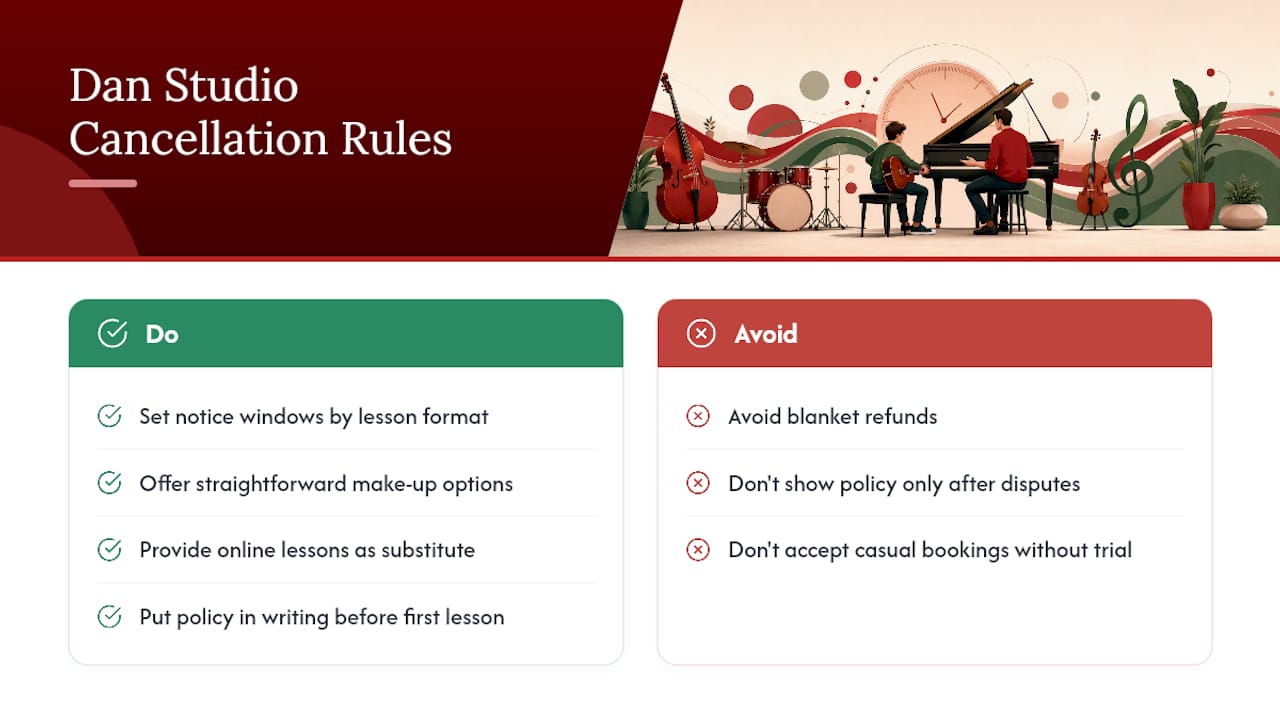
Piano teaching runs on booked time, not stock. A missed lesson slot, whether in person or online, can’t be resold five minutes later, which is the whole reason a clear cancellation policy exists in the first place, not as a penalty but as a way of respecting both sides of the booking.
In practice, that means reasonable notice windows tied to the lesson format, straightforward make-up options rather than blanket refunds, and a trial lesson structure that filters out casual bookings before they become no-shows. Reminders go out ahead of every session, and online lessons are offered as a genuine substitute when an in-person slot falls through. The rule worth copying from day one: put the policy in writing before the first lesson, not after the first dispute.
— Dan
Ready to book a lesson under terms you can actually see in advance? Explore home piano lessons or check current plans and pricing before your first session.
Sources
Recommended


Comments