


Jazz piano voicings for beginners: play ii–V–I now


Jazz piano voicings are the specific note arrangements you choose to colour a chord. Rather than playing every note in a stack, you select which tones to include, which to omit, and where to place them across both hands. The most important rule from day one: the 3rd and 7th of any chord carry the harmonic information. Everything else is colour. Start with two shell voicings and two rootless guide-tone shapes, and you can comp over a ii–V–I in C before the end of your first practice session.
Here are your first three actions right now:
Play shell voicings on a ii–V–I in C: Dm7 (left hand: D + C), G7 (left hand: G + F), Cmaj7 (left hand: C + B). Notice how little your hands move.
Practise guide-tone voice leading: on G7, the 3rd is B and the 7th is F. When you resolve to Cmaj7, B stays and F moves down a semitone to E. That smooth half-step motion is the sound of jazz.
Try a simple comping rhythm: place your left-hand shell on beat 1, then add a right-hand extension on the “and” of 2. Leave beat 4 empty. That space is doing harmonic work.
Table of Contents
Your quick-start cheat sheet for essential jazz voicings
The shapes below are reproducible on any piano. Fingering suggestions assume a standard adult hand; adjust as needed.
Shell voicings
Shell voicings use only the root, 3rd, and 7th. They are the fastest route to smooth voice leading and leave plenty of room for a bassist.

Chord | Left hand | Right hand | Notes |
Dm7 (ii) | D + C (root + ♭7) | F + A (3rd + 5th) | Hands barely move chord to chord |
G7 (V) | G + F (root + ♭7) | B + E (3rd + 13th) | 13th adds colour without clutter |
Cmaj7 (I) | C + B (root + maj7) | E + G (3rd + 5th) | Bright, open sound |
Dm7♭5 (ii°) | D + C (root + ♭7) | F + A♭ (♭3rd + ♭5th) | Minor ii–V–I starting point |
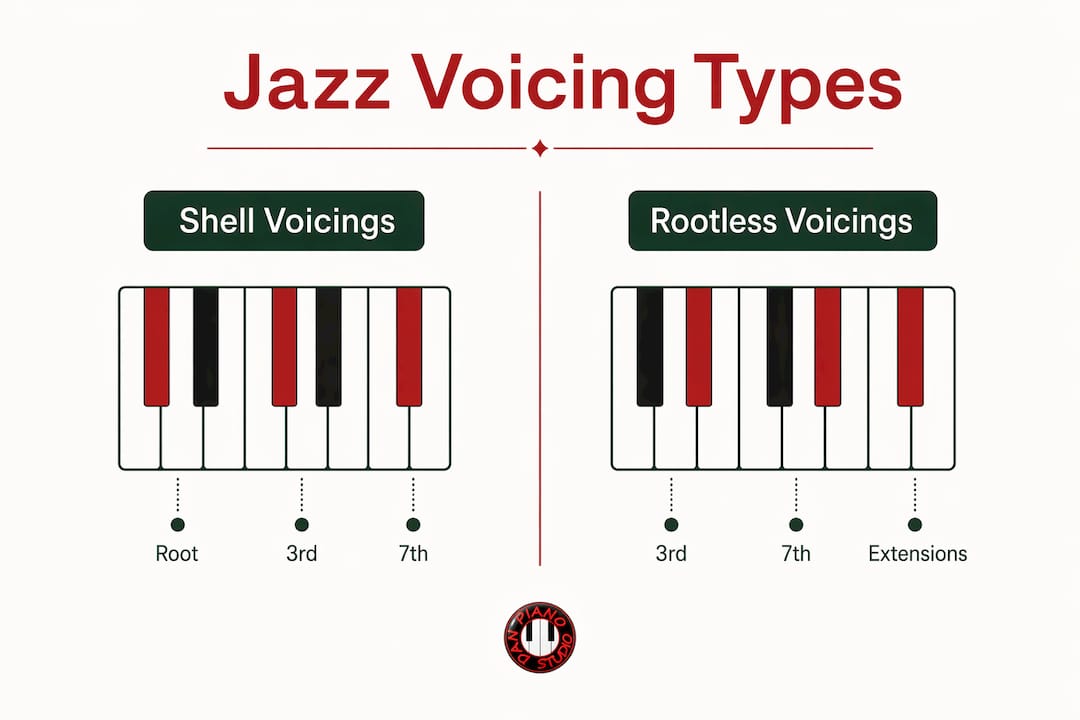
Rootless guide-tone voicings (Type A and Type B)
When a bassist is present, drop the root entirely. Rootless dominant voicings use the 3rd and 7th as anchors with extensions above.
Voicing | Notes (left hand only) | Character |
G7 Type A | B + F + A + E♭ (3, ♭7, 9, ♭13) | Warm, slightly altered |
G7 Type B | F + B + D + A♭ (♭7, 3, 5, ♭9) | Tenser, more chromatic |
Place these voicings in the middle register of the keyboard above middle C but not too high. Lower than a certain point the sound can turn muddy; higher and it loses body.
Pro Tip: Keep your left-hand voicings between the F below middle C and the C above it. That register sits above the bass player’s territory and below the soloist’s range — exactly where your comping belongs.
What are the core voicing families and when do you use them?
Jazz treats 7th chords as the baseline, not triads. Extensions such as 9ths, 11ths, and 13ths are added for colour once the basic shapes are solid. Understanding why each voicing family exists helps you choose the right one in the moment.
Shell voicings
A shell voicing is root plus 7th (or root plus 3rd plus 7th) in the left hand. Shell shapes are the first tool a beginner should own because they create smooth inner-voice motion and leave space for the bass. At fast bebop tempos, shells are often all you need.
Guide-tone voicings
Guide tones are the 3rd and 7th of a chord. They define the chord’s quality and function. When you move from G7 to Cmaj7, the 3rd (B) holds and the 7th (F) resolves down a semitone to E. That half-step resolution is the engine of jazz harmony, and it works identically in a minor ii–V–I: on Dm7♭5 to G7alt, the ♭7 © resolves down to B, the 3rd of G7. Practise hearing these two notes move before you add anything else.

Rootless four-note voicings
Once you are comfortable with shells, rootless voicings open up the full jazz palette. The bassist covers the root, so you can use both hands for colour tones. Alternating Type A and Type B rootless positions across a ii–V–I produces smooth inner-voice connections with minimal hand movement, which is exactly what experienced compers do.
Quartal voicings
Quartal harmony stacks intervals of a 4th rather than 3rds. The “So What” voicing, D–G–C–F in the left hand with A in the right, was popularised on Bill Evans’s 1959 recording of Kind of Blue and remains a reference for modal jazz comping. Quartal shapes work especially well over static or modal vamps where functional harmony is suspended.
Upper-structure triads
An upper-structure triad places a simple major or minor triad in the right hand above a guide-tone shell in the left. For example, over G7alt, a left hand of B + F (3rd and ♭7) with a right-hand D♭ major triad (D♭–F–A♭) gives you the ♭5, ♭7, and ♭9 simultaneously. The result is a dense, altered dominant sound that resolves powerfully to Cmaj7.
The table below shows how the voicing families compare across key criteria:
Voicing type | Root included? | Best context | Complexity |
Shell | Yes | Solo piano, fast tempos | Low |
Guide-tone | Optional | Ensemble comping | Low–medium |
Rootless (Type A/B) | No | Ensemble with bassist | Medium |
Quartal | Optional | Modal, contemporary | Medium |
Upper-structure triad | No | Altered dominants, advanced | High |
Key priorities when building your voicing vocabulary:
Learn shells first; they work in every context and build the muscle memory for guide-tone movement.
Add rootless shapes once you are playing regularly with a bassist or a play-along track.
Introduce quartal and upper-structure voicings when you are comfortable transposing shells across all 12 keys.
How do you choose the right voicing in the moment?
The melody is your primary guide. If the melody note is the 9th of the chord, choose a voicing that contains or complements that 9th rather than one that clashes with it. If the melody sits on the 3rd, avoid adding an extension a semitone away. This principle applies whether you are comping behind a singer or playing a chord-melody arrangement.
A compact decision framework:
Melody contains chord tones (root, 3rd, 5th): use a thin voicing, shell or guide-tone only. Density competes with the melody.
Soloist needs space: drop to a rootless shell. Two or three notes, placed rhythmically, support without crowding.
You need colour: add a 9th, #11, or 13th above the guide tones. The #11 (Lydian sound) works beautifully over major chords; the ♭9 and #9 create tension over altered dominants.
Pro Tip: When you are unsure which extension to add, listen to what the melody is doing. If it emphasises the 9th, keep the 9th in your voicing. If it sits on the 3rd, leave the 9th out. The melody is always the boss.
Reading the band situation matters as much as chord theory. When a bassist is playing, omit the root. When a horn player is soloing in the upper register, keep your voicings in the middle of the keyboard. When the drummer is playing a dense pattern, simplify to two or three notes and focus on rhythmic placement rather than harmonic density.
Altered dominants deserve a specific mention. A G7 with a ♭9 sounds tense and slightly dark, pulling strongly to Cmaj7. Adding a #9 (the “Hendrix chord” tone) gives a bluesy, ambiguous quality. A #11 over G7 creates a Lydian dominant sound, brighter and less resolved. Each alteration changes the emotional colour of the resolution, so choose based on the mood of the tune, not just the chord symbol.
For a deeper look at how extensions and altered dominants fit into the broader harmonic picture, the guide to jazz piano harmony at Danpianostudio covers modal approaches and reharmonisation in detail.
Practice drills that actually build your voicing skills
Mastering the ii–V–I across all 12 keys is the single most effective practice investment for any jazz pianist. Rather than memorising hundreds of voicing variations, focus on a small set of reliable shapes and transpose them systematically.
Step-by-step drills
Guide-tone move drill: play G7 with just B and F in the left hand. Resolve to Cmaj7 with B and E. Repeat until the movement is automatic. Then do the same for every dominant-to-tonic resolution in the cycle of 4ths.
Shell-voicing cycle: play a ii–V–I in C using shells, then move to F, then B♭, then E♭. Cover six keys in one 15-minute session. The cycle of fourths is your roadmap.
Rootless Type A/B alternation: play G7 Type A resolving to Cmaj7, then repeat with Type B. Alternate between the two positions across the same ii–V–I. Notice how each position creates a different inner-voice path to the resolution.
12-key practice schedule
Day | Keys to cover | Focus |
Monday | C, F | Shell voicings, guide-tone resolution |
Tuesday | B♭, E♭ | Rootless Type A |
Wednesday | A♭, D♭ | Rootless Type B |
Thursday | G♭, B | Alternating Type A and B |
Friday | E, A | Minor ii–V–I (Dm7♭5 → G7alt → Cm) |
Saturday | D, G | Comping rhythm drills over all shapes |
Sunday | All 12 | Play one standard using the week’s voicings |
Comping rhythm drills
The Charleston pattern (beat 1 and the “and” of 2) is the foundation of jazz comping rhythm. Start there. Once it feels natural, try placing a chord only on the “and” of 2 and leaving everything else silent. That single displaced chord, surrounded by space, often swings harder than four beats of dense harmony. Practise at a slow tempo (crotchet = 60–70) before pushing the speed.
Homework challenge: take one jazz standard you enjoy, Autumn Leaves or All The Things You Are are good starting points, and comp through it using only shell voicings for the first week. Record yourself. The recording will reveal whether your guide-tone voice leading is smooth or whether you are jumping between unrelated shapes.
Common mistakes that kill the jazz feel (and quick fixes)
Most beginners make the same handful of errors. The good news is that each one has a fast fix.
Doubling the root when a bassist is present. The bass player owns the root. When you double it in the left hand, the sound becomes thick and the harmony loses clarity. Drop the root and let the guide tones do the work.
Playing on every beat. Comping on every crotchet deadens the swing feel. Sparse placement with rhythmic intention swings far harder than constant chord coverage.
Ignoring guide-tone voice leading. Jumping between unrelated voicings sounds like you are playing separate chords rather than a connected progression. Keep the guide tones moving by step or semitone.
Staying in C only. Transposing voicings into all 12 keys from the start is non-optional for ensemble readiness. A voicing you only know in C will desert you the moment a saxophonist calls a tune in B♭.
Voicings placed too low on the keyboard. Anything below the F below middle C starts to sound muddy. Move up.
Pro Tip: Use silence as a harmonic device. A well-placed rest after a chord lets the sound breathe and tells the rhythm section where you are in the bar. Try playing one voicing per bar for an entire chorus of a standard. It is harder than it sounds and more musical than you expect.
One habit change to test in your next rehearsal: for the first eight bars of any tune, play no more than two chords per bar. Count the rests. Notice whether the band responds differently.
Dan Piano Studio’s 12-week starter plan for jazz voicings
This plan is structured around weekly lesson goals and daily practice targets. Each week builds on the last, so resist the urge to skip ahead.
Weeks 1–2: Shell voicings in C, F, and B♭. Daily target: 20 minutes. Lesson focus: guide-tone identification and smooth resolution on ii–V–I.
Weeks 3–4: Shell voicings in all 12 keys using the cycle of 4ths. Daily target: 25 minutes. Lesson focus: voice-leading check, tempo control, first comping rhythm (Charleston pattern).
Weeks 5–6: Rootless Type A voicings on dominant chords. Daily target: 30 minutes. Lesson focus: register placement, leaving space for the bass, applying Type A to one standard.
Weeks 7–8: Rootless Type B voicings and alternation between Type A and B. Daily target: 30 minutes. Lesson focus: inner-voice smoothness, minor ii–V–I introduction.
Weeks 9–10: Extensions and altered dominants (♭9, #9, #11). Daily target: 35 minutes. Lesson focus: melody-matching, choosing alterations by ear, comping behind a play-along.
Weeks 11–12: Quartal voicings and upper-structure triads on one modal standard. Daily target: 35 minutes. Lesson focus: recorded performance review, repertoire consolidation.
Progress checklist at the end of week 12:
ii–V–I in all 12 keys using shells and rootless voicings ✓
Comping over one complete jazz standard with rhythmic variation ✓
Minor ii–V–I (Dm7♭5 → G7alt → Cm) in at least four keys ✓
Recorded performance reviewed with teacher feedback ✓
At Danpianostudio, each weekly lesson includes a voicing check at the start (teacher plays a chord, student identifies and voices it), new material introduction, and a specific homework assignment tied to the week’s key targets. Students working through jazz piano instruction at this pace typically reach ensemble-ready comping within three months.
How to add rhythmic variation to your comping
Chord choice is only half of comping. The rhythm you place those chords on is equally important, and often more immediately noticeable to a listener.
Start with the Charleston pattern and treat it as a template rather than a rule. Once it is automatic, try displacing the chord slightly earlier or later. Such small shifts change the feel from square to syncopated without altering any notes. Jazz pianists like Herbie Hancock and McCoy Tyner built entire comping vocabularies on rhythmic displacement of relatively simple voicings.
Polyrhythmic placement is a more advanced tool. Try placing chords in a three-against-four pattern over a standard swing feel. The chords land in unexpected places, creating a sense of forward momentum that pulls the soloist along. This works best with sparse, two-note voicings; dense chords in odd rhythmic positions sound cluttered rather than interesting.
Silence is a rhythmic device too. Leaving two full bars empty, then placing a single chord on beat 3 of bar 3, creates tension and release that no amount of harmonic complexity can replicate. Practise this deliberately: set a metronome, play one chord, and count four bars before playing the next. The discipline of waiting teaches you where the music actually needs support.
Vary your note lengths as well. A short, staccato chord on the “and” of 2 feels different from a sustained chord held through beat 3. Mixing short and long articulations within a single chorus adds texture that keeps the accompaniment alive.
How drums and bass should shape your voicing choices
Playing in an ensemble is a conversation, not a monologue. Your voicing choices need to account for what the rhythm section is doing, not just what the chord symbol says.
The bassist defines the harmonic foundation. When the bass is playing the root clearly, you are free to go rootless and focus entirely on colour tones. When the bassist is walking a line that moves through passing tones, a simpler voicing from you prevents harmonic clutter. Listen to the bass before you decide what to play.
The drummer’s density matters too. A busy, complex drum pattern calls for sparse comping, two or three notes placed rhythmically. A sparse, brush-driven groove gives you more space to sustain voicings and add extensions. The piano and drums share the rhythmic middle ground of the band; when both are dense simultaneously, the music loses air.
Register is a practical consideration as well. If the bassist is playing in the low register and the soloist is in the upper register, your voicings belong in the middle, roughly between the F below middle C and the C above it. Avoid the bass register entirely when a bassist is present; anything below that F will clash physically with the bass frequencies and muddy the mix.
One useful habit: before your first chord of a tune, listen for two bars. Hear what the bass is doing rhythmically, where the drummer is placing accents, and what register the soloist is working in. That two-bar listen tells you more about what voicing to choose than any chord chart. Jazz clarinetists and horn players, for instance, tend to phrase in longer arcs with space between ideas; that space is your cue to place a chord. You can hear this kind of melodic phrasing in action by studying jazz clarinetists who work with piano accompaniment.
Key takeaways
Shell voicings and rootless guide-tone shapes are the fastest route to sounding like a jazz pianist: learn two of each, transpose them through all 12 keys via the ii–V–I, and your comping will be ensemble-ready within weeks.
Point | Details |
Start with guide tones | The 3rd and 7th define every chord; master their voice leading before adding extensions. |
Learn four shapes first | Two shell voicings and two rootless positions (Type A and Type B) cover most comping situations. |
Transpose immediately | Practise every new voicing in all 12 keys from the first session; staying in C only limits ensemble readiness. |
Rhythm matters as much as harmony | Sparse, rhythmically placed chords swing harder than dense coverage on every beat. |
Danpianostudio’s 12-week plan | A structured weekly lesson and daily practice schedule takes beginners to ensemble-ready comping in three months. |
A teacher’s perspective on learning voicings
The students who progress fastest with jazz voicings are rarely the ones who learn the most shapes. They are the ones who learn fewer shapes and use them in more contexts. A student who can play a rootless Type A voicing in all 12 keys, place it rhythmically, and adjust it to the melody is more musically useful in an ensemble than someone who has memorised thirty voicing diagrams but only practised them in C.
The other thing that separates quick learners is listening. Playing along with recordings, even just as a listening exercise rather than active comping, builds an intuitive sense of register, density, and rhythm that no amount of theory study replicates. Pick one Bill Evans or Herbie Hancock recording and listen specifically to the left hand. Notice what it does not play as much as what it does.
At Danpianostudio, lessons are structured so that every new voicing concept is applied to a real tune within the same session. Theory without application is just memorisation. If you want personalised feedback on your guide-tone voice leading or help choosing the right voicings for a specific standard, bring the tune to your first lesson and we will work through it together. Online lessons and in-studio sessions in Central London are both available, and the beginner piano learning guide on the Danpianostudio blog is a useful starting point for structuring your practice between sessions.
Ready to play jazz voicings with a teacher’s guidance?
Danpianostudio offers jazz piano lessons for beginners and intermediate players, both in Central London (Camden and King’s Cross) and online, with every lesson tailored to where you actually are rather than a fixed syllabus. If you have been working through the shapes in this guide and want real-time feedback on your voice leading, comping rhythm, or how to apply voicings to a specific standard, a lesson is the fastest way to accelerate.
The first lesson focuses on what you already know and where the gaps are, so there is no wasted time. Whether you prefer in-home lessons in London or the flexibility of online piano lessons, you can book directly through the Danpianostudio website. Bring a tune you love and we will start there.
Useful sources and play-along resources
The following resources support the concepts covered in this guide. Use them alongside your practice sessions rather than as a substitute for playing.
Resource | What it covers | How to use it |
Berklee Online — Piano Voicing Techniques | Voice leading rules, tension placement, register guidance | Read alongside the core voicing types section; apply the register rules immediately |
eJazzNews — Jazz Piano Chords Guide | Shell, rootless, and quartal voicing explanations with examples | Use as a reference when building your cheat-sheet shapes |
eJazzNews — How to Play Jazz Piano | Practice routine templates (30–35 minute sessions) | Structure your daily practice using the session templates |
NY Jazz Academy — Practice Guidance | Chunking advice: focus on core progressions rather than infinite variations | Apply the chunking principle to the 12-week plan |
Jens Larsen — 5 Chord Progressions | The five progressions that cover most jazz harmony needs | Use to select repertoire for your weekly standard |
Learn Jazz Standards — ii–V–I Guide | Progression analysis and voicing suggestions for standards | Cross-reference when applying voicings to real tunes |
Jazzadvice — 10 Essential Progressions | Harmonic context for each progression type | Study alongside the minor ii–V–I and modal vamp sections |
Play-along recommendations:
For shell voicing practice, use a play-along at crotchet = 100–120 (medium swing). iReal Pro is widely used for this purpose and allows you to set any tempo and key.
For rootless voicing practice, slow the tempo to crotchet = 70–80 and focus on placing each chord rhythmically rather than on every beat.
For the 12-key drill, use the cycle of 4ths as your key sequence and spend two minutes per key before moving on.
The Danpianostudio blog contains additional practice guides, harmony explanations, and lesson resources that complement the material here.
Recommended



Comments