


Six chord progressions every piano player should learn first


Learn these six progressions first: I–V–vi–IV, I–IV–V, I–vi–IV–V, ii–V–I, the Pachelbel sequence, and the Andalusian cadence. Each one shows up constantly across pop, folk, jazz and classical writing, and together they cover most of what you will ever need to accompany, improvise, or compose.
The fastest way to learn any of them is the same four-step route every time: work out the Roman numerals in your chosen key, play the chords as simple blocks in the right hand, tidy up the voice leading so your hand barely moves, then transpose the whole thing into two or three other keys before you call it learnt.
I–V–vi–IV — the four-chord loop behind hundreds of pop songs
I–IV–V — the three-chord backbone of blues, folk and rock
I–vi–IV–V — the “doo-wop” turnaround with a slightly wistful lift
ii–V–I — the jazz cadence that resolves like a held breath finally let go
Pachelbel sequence — a longer, descending chain used across classical and pop
Andalusian cadence — a minor-key descent with a flamenco, cinematic feel
By the end of a session working through these, you should be able to play along to a recording, improvise a short melody over a loop, or sketch the harmony for an original phrase.
Key Takeaways
Mastering chord progressions on piano comes down to learning six core patterns in Roman numerals, practising them through a fixed sequence of blocks, voice leading and transposition, then applying them to real melodies.
Point | Details |
Learn six progressions first | I–V–vi–IV, I–IV–V, I–vi–IV–V, ii–V–I, Pachelbel and the Andalusian cadence cover most popular styles. |
Use Roman numerals, not letter names | They describe chord relationships, so one learnt pattern transposes instantly to any key. |
Practise in a fixed order | Move from block chords to voice leading, then arpeggios and comping, then transposition drills. |
Rhythm changes the feel, not the harmony | The same chords played with different timing or bass placement can sound propulsive, spacious or reflective. |
Guided lessons speed recognition | Danpianostudio structures progression practice into demonstration, guided practice and repertoire application, useful for casual improvement or ABRSM/Trinity preparation. |
Table of Contents
Understanding chord progressions piano players use in every key
A chord progression is just a sequence of chords played in order, and the reason every serious pianist learns to read one in Roman numerals rather than letter names is transposition. Write a progression as I–V–vi–IV and it works in C, in G, in E flat, in any key you like, without you having to relearn a single shape. Letter names (C, G, Am, F) only describe one specific key; Roman numerals describe the relationship between chords, and that relationship is what actually carries the sound.
Harmonising a scale means building a triad on every note of that scale using only notes that belong to it. Here is the quick version for C major:
C major scale: C–D–E–F–G–A–B gives you the chords C, Dm, Em, F, G, Am, Bdim (that’s I, ii, iii, IV, V, vi, vii°).
A natural minor scale: A–B–C–D–E–F–G gives you Am, Bdim, C, Dm, Em, F, G (i, ii°, III, iv, v, VI, VII).
Group them by function: I, IV and V are the sturdy “tonic, subdominant, dominant” trio that anchors almost every progression; ii, iii and vi are their softer relatives, often swapped in for colour.
Pro Tip: Once you’ve harmonised one major and one relative minor scale by hand, you’ve effectively learnt the chord map for every key. The pattern of intervals never changes, only the starting note does.
Playing the core progressions: patterns, examples and why they work
Start with I–V–vi–IV in C major: C, G, Am, F. Played as block chords in the right hand with a single root note in the left, it loops endlessly without ever fully resolving, which is exactly why writers love it. Rotate the same four chords to begin on vi instead (Am, F, C, G) and you get a slightly moodier opening with an identical harmonic skeleton. This is the single most recognisable four-chord pattern in Western pop, and once your fingers know it in one key, moving it is a five-minute job.
I–IV–V (C, F, G in the key of C) is the three-chord foundation behind blues, folk and early rock and roll. Stretch it into a twelve-bar blues form and you have the harmonic engine behind an entire genre. It’s blunt and satisfying, and it’s usually the first progression teachers hand to complete beginners because there’s nowhere to hide: get the changes clean and it already sounds like music.
I–vi–IV–V (C, Am, F, G) is the so-called doo-wop turnaround, common in 1950s and 60s pop and still borrowed constantly today. The vi chord gives it a gentler dip before the IV–V push back towards home, which makes it useful for melodies that want a moment of reflection before resolving.
ii–V–I is jazz’s signature cadence. In C, that’s Dm7, G7, Cmaj7. Teach yourself the plain triads first (Dm, G, C) so your ear locks onto the resolution, then add the sevenths once the movement feels automatic. Jazz pianists rarely play it once; they chain it, stacking ii–V–I units through a tune’s key changes, which is worth exploring properly in a guide to jazz piano harmony if the sound grabs you.
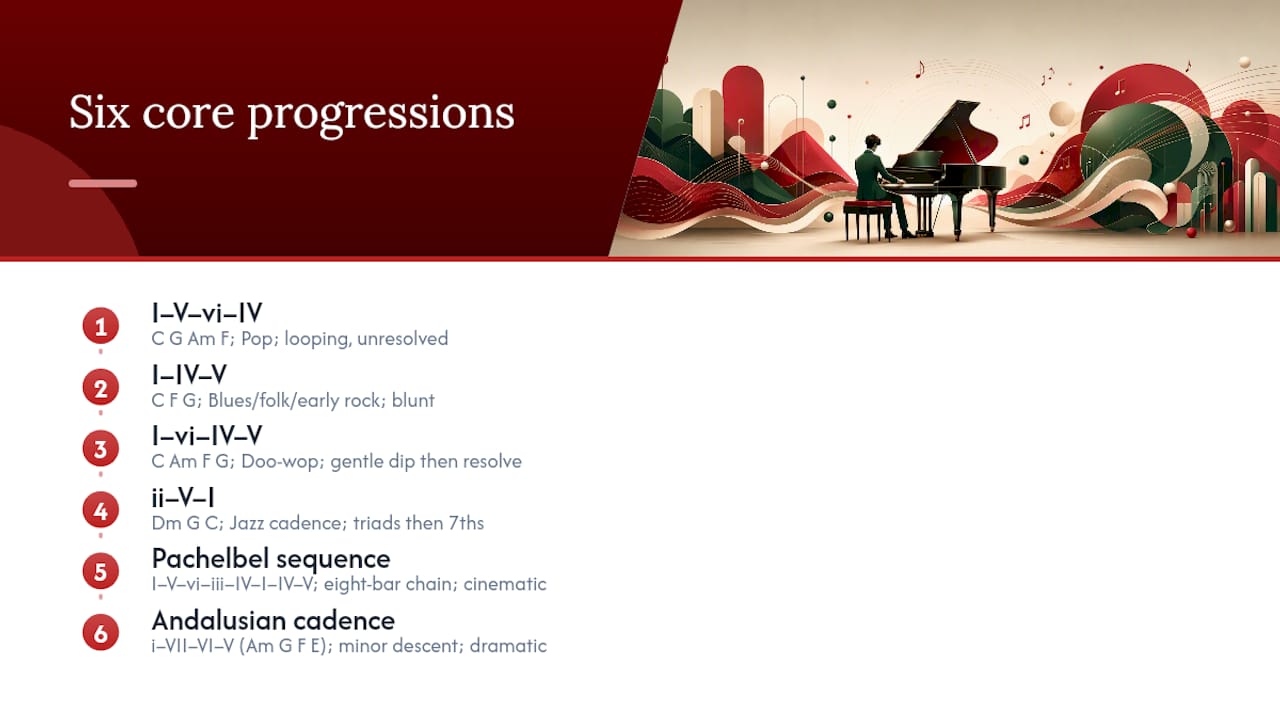
The Pachelbel sequence (I–V–vi–iii–IV–I–IV–V, or a close variant) is longer and more deliberate, first known from Pachelbel’s Canon in D and borrowed endlessly since in pop ballads and film scores. It rewards patience because the chain takes eight bars to resolve, not four.
The Andalusian cadence (i–VII–VI–V, so in A minor that’s Am, G, F, E) descends stepwise through a minor scale and carries a Spanish, almost cinematic weight. It’s a favourite for anyone wanting drama without needing jazz harmony.
A handful of named progressions like these structure a striking share of popular, jazz, and classical repertoire, and pedagogical resources consistently pair each one with a playable voicing and a listening example so students hear the effect before they analyse it, a method Pianists Compass uses to good effect. Notice, too, how pop tends to loop these progressions as short repeating cells, while classical writing more often uses them to travel somewhere, building towards a cadence or a key change rather than circling back.
Practice steps that build smooth, confident playing
Chord progressions only sound good when the transitions between them are quiet. Here’s the order that works:
Block chords, right hand, steady bass, left hand. Play each chord as a solid block and hold a single root note underneath. Get this locked before you add anything fancy.
Apply voice leading. Keep any note shared between two chords stationary, and move the remaining notes to the nearest available tone rather than jumping. Moving from I to vi in C, for instance, the third of the C chord (E) can often stay put as you shift the shape beneath it, which cuts unnecessary hand travel and makes the change audible rather than clumsy.
Break into arpeggios and simple comping. Once the blocks are smooth, spread the notes out, or try a light left-right alternation, the kind of rhythmic comping jazz pianists use behind a soloist.
Transpose across three keys in one sitting. Play your progression in C, then jump a perfect fifth up, then a minor third down, then back to C. This single drill builds interval familiarity faster than working through keys one at a time in sequence.
Watch for two common faults: lifting the hand fully between chords (it kills the legato and wastes time), and over-stretching for a voicing instead of choosing a smaller, closer shape. Both fixes come down to the same instinct: move less, not more.
Pro Tip: Beginners tend to improve transitions fastest by nailing block chords first and only then reaching for arpeggios and comping patterns, rather than trying to sound impressive from bar one.
Using progressions to compose and improvise with confidence
A looping progression is really just a backing track waiting for a melody. Play I–V–vi–IV on repeat and hum or noodle a simple tune over the top; you’re composing, even if it doesn’t feel like it yet.
Sketch a melody first, harmony second, or the reverse: both routes work, but committing to a four-chord loop before you write a tune removes half the decision fatigue.
Use inversions and rotations for variety without changing a single chord: starting I–V–vi–IV on the vi instead gives you an entirely different mood from identical harmony.
Add passing chords or a simple substitution to colour a loop, swapping IV for ii is a gentle, low-risk first experiment.
Try a pivot-chord modulation: find a chord shared between your current key and a new one, use it as the hinge, and you can shift a whole section up without a jarring key change.
Map a verse and chorus onto one progression, then vary only the rhythm or register between sections, a trick that explains why so many songs feel unified despite having “different” parts.
How rhythm and timing shape the feel of a progression
The same four chords played as slow, sustained blocks feel completely different from those chords chopped into a syncopated left-hand pattern, even though the harmony hasn’t moved an inch. Rhythm is doing half the emotional work in most piano writing, not the chord choice itself.

Try I–vi–IV–V played as even quarter notes, then again with the bass note landing slightly ahead of the beat and the chords held back a fraction, that small delay (sometimes called a “push and lay”) is where a lot of soul and gospel piano gets its lean-back feel. Switch to a straight eighth-note ostinato and the identical progression suddenly sounds propulsive, almost mechanical, which is exactly the effect minimalist and electronic composers chase.
Where you place the bass note matters too. A root played squarely on beat one grounds a progression; delaying it to the “and” of one, or dropping it an octave lower, makes the same harmony feel weightier or more spacious. Try playing I–IV–V with the left hand landing on every beat, then try it with the bass only on beats one and three, leaving space for the right hand to breathe. Same chords, two different songs.
Training your ear to hear progressions before you play them
Recognising a progression by ear is a skill you build the same way you build any other: small, repeated exposure with immediate feedback. Start by listening to a song you know well and trying to sing the bass line before you touch the keys, most pop bass lines simply outline the chord roots, so if you can hum the bass, you already know the harmony.
Next, play I–IV, then I–V, then I–vi in isolation and say out loud what each shift feels like: IV usually feels like lifting slightly, V feels like tension wanting to resolve, vi feels like a dip into shadow. Once those feelings are attached to the sound rather than the theory, you can start predicting: play I, pause, and guess what’s coming next before you play it. You’ll be wrong plenty at first. That’s the point.
A useful drill is playing a familiar four-chord loop with your eyes closed and naming each chord’s function (tonic, subdominant, dominant, relative minor) the instant you hear it change, rather than after. Do this daily for a fortnight with a handful of songs and the recognition speed improves noticeably, because you’re training pattern recall, not just theory recall.
Genre by genre: how the same chords sound completely different
Pop music leans heavily on I–V–vi–IV and its rotations precisely because the loop never fully resolves, which gives producers and melody writers an open platform to layer variety on top without the harmony demanding attention. That avoidance of full resolution is a large part of why the pattern feels so replayable rather than exhausting.
Blues and early rock lean on I–IV–V, usually stretched into a twelve-bar form with a shuffle feel, and the simplicity is deliberate: the harmony gets out of the way so the vocal or lead line can carry the emotional weight.
Jazz standards live and breathe on ii–V–I, often chained through several keys in a single tune, coloured with sevenths, ninths and alterations that would sound cluttered in a pop context but feel entirely natural once a swung rhythm section is holding the pulse.
Classical writing tends to use progressions like Pachelbel’s sequence to travel somewhere, building through a chain of chords towards a cadence rather than looping indefinitely, which is the clearest structural difference between pop and classical harmony.
Flamenco and film composers reach for the Andalusian cadence because its descending minor motion carries built-in drama without needing complex voicings, useful shorthand when a scene or a solo guitar line needs weight fast.
Adding colour: sevenths, ninths and suspensions
Every progression above works perfectly well as plain triads, but adding extensions is how you move from “correct” to “interesting”. A seventh chord adds one extra note a third above the top of the triad: turn G major into G7 and you sharpen the pull towards C, which is exactly why dominant sevenths sit so naturally at the “V” spot in almost any progression.
Ninths stack one note further, softening a chord’s edges without disturbing its core function, Cmaj9 instead of Cmaj7 sounds lusher without sounding “wrong” in the same slot. Jazz pianists lean on ninths constantly for exactly this reason: more colour, same harmonic job.
Suspensions delay a chord tone rather than adding one. A Csus4 holds the fourth where the third would normally sit, creating a moment of held tension before it resolves down into the plain major chord, a favourite trick for softening the arrival of a I chord rather than landing on it flatly. Try swapping a plain V for Vsus4 resolving to V in a I–IV–V progression and listen to the extra half-second of anticipation it buys you.
None of these extensions change the underlying Roman numeral function. A G7 is still a V chord; it’s simply a V chord wearing a slightly richer coat, which is why you can layer this vocabulary onto every progression already covered without relearning anything structural.
Why guided practice speeds up progression mastery
Working through progressions alone gets you competent. A structured lesson gets you fluent faster, because a teacher spots the tension you can’t hear yet, the stretch that will cause tension in six months, or the voicing that would sound better with one small change. My own lessons follow a simple sequence: demonstration, guided practice, targeted exercises, then applying the same progression inside real repertoire, so it never stays an abstract drill.
For students working towards ABRSM or Trinity exams, this matters more than most people expect. Aural tests and sight-reading both reward a player who recognises a ii–V–I or a I–vi–IV–V on sight rather than working it out note by note, and that recognition is built exactly the way this article has described it, through repeated, guided exposure. If you want a fuller roadmap for structuring that kind of practice at home, our beginner piano learning guide expands on several of these drills in more depth.
Book piano lessons in Central London or online with Danpianostudio
If you have worked through the progressions above and want someone to catch the small habits you can’t hear in your own playing, that is exactly the gap private tuition closes. Danpianostudio runs lessons for complete beginners who need I–IV–V to feel solid under their fingers, for intermediate improvers ready to chain ii–V–I through a jazz standard, and for exam candidates who need chord recognition built into their aural and sight-reading preparation for ABRSM or Trinity.
Lessons run in person across Central London, Camden and King’s Cross, or online if you’d rather practise from home with the same structured guidance. A first lesson usually starts with a quick assessment of where your playing sits, then moves straight into practical work rather than lengthy theory, so you leave with something new under your fingers on day one. If you’re preparing for a graded exam, the ABRSM and Trinity pathway folds progression work directly into your repertoire and aural preparation. Get in touch through Danpianostudio to find a lesson slot that fits your week.
Where to study chord progressions further
For deeper theory on harmonising scales and transposition, piano.org’s chord progression guide is a solid reference. Piano Log and Pianists Compass both pair named progressions with listening examples. For general practice discipline that transfers well to piano, this clarinet practice routine offers useful principles on structuring focused sessions.
Frequently asked questions
What is the easiest chord progression to learn on piano? I–IV–V is usually the simplest starting point. In C major that’s C, F and G, three chords built entirely from white notes with no tricky stretches, which is why it underpins so much blues and folk repertoire.
How do I transpose a chord progression to a different key? Work out the progression’s Roman numerals in your original key, then rebuild the same numerals from the new key’s tonic. Practising a progression in C, up a fifth, down a minor third, then back to C in a single session builds this skill faster than moving through keys one at a time.
Why do so many songs use the same chord progressions? A handful of patterns, particularly I–V–vi–IV, avoid full harmonic resolution, which keeps them replayable and gives writers an open platform for melody and production without the chords demanding attention.
How long does it take to memorise the main piano chord progressions? Most players can play all six core progressions as block chords in one key within a single practice session. Comfortable transposition and smooth voice leading across multiple keys typically takes several weeks of regular short practice sessions.
Do I need to learn seventh chords before I can use these progressions? No. Every progression here works fine as plain triads, and that’s how beginners should start. Sevenths, ninths and suspensions add colour later without changing the underlying Roman numeral function.
Sources
Recommended


Comments