


ABRSM marking scheme: the complete guide for candidates


The ABRSM marking scheme allocates a total of 150 marks across all components in both Practical and Performance Grades, with official descriptor bands for Distinction, Merit, Pass and Below Pass available to download directly from ABRSM’s qualification specification pages. The two essential starting points are the Practical Grades page and the Performance Grades qualification specification PDF, both of which contain the full examiner criteria used in every sitting.
At a glance, the framework works like this:
Total marks: 150 for both Practical and Performance Grades
Distinction: top award band
Merit: mid award band
Pass: basic pass band
Below Pass: below standard
Table of Contents
How does the ABRSM marking scheme break down for Practical Grades?
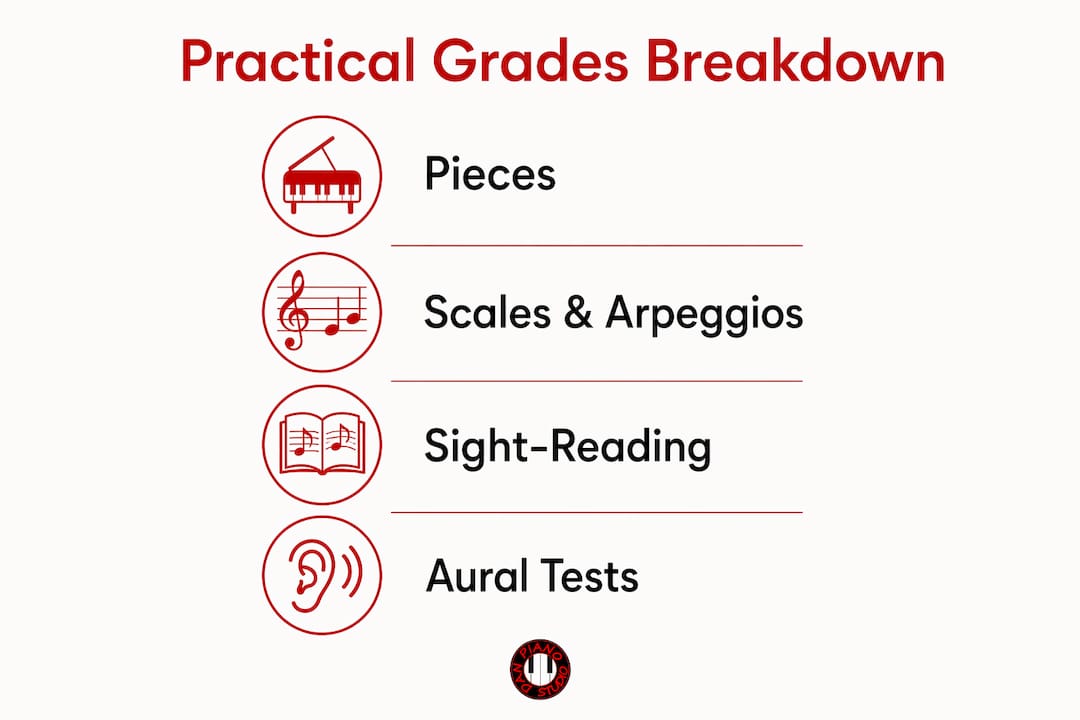
Practical Grades divide those 150 marks across four components. The exact allocation can vary slightly by instrument, so always check the instrument-specific syllabus, but the standard piano breakdown runs as follows:
Component | What examiners assess |
Pieces/Songs | Multiple musical criteria such as pitch, time, tone, shape, performance |
Scales/arpeggios | Technical and musical accuracy and fluency |
Sight-reading | Continuity and musical character |
Aural tests | Listening skills and musical awareness |
What examiners actually listen for in each component:
Pieces: The five criteria are pitch, time, tone, shape and performance. Examiners are not ticking boxes; they weigh how these qualities combine to create a convincing musical result.
Scales and arpeggios: Evenness of tone and rhythm, accurate fingering, and a sense of direction through the pattern. A scale that is technically correct but rhythmically lumpy will not score as highly as one that feels musical.
Sight-reading: Continuity matters more than perfection. Keeping the pulse and capturing the character of the passage counts for more than stopping to correct a wrong note.
Aural tests: Active listening and a confident, prompt response. Hesitation or vague answers cost marks even when the underlying perception is correct.
Pro Tip: Pieces carry 60% of the total mark between them in Practical Grades. If practice time is limited, a focused 20-minute session on the weakest piece will move the overall total more than the same time spent on scales, which contribute only 14%.
How are Performance Grades marked differently?
Performance Grades replace scales, sight-reading and aural tests with a fourth piece and a separate synoptic component. The allocation is clean and symmetrical: four pieces at 30 marks each, plus 30 marks for the performance as a whole, totalling 150.
Each piece is marked against the same five criteria used in Practical Grades:
Pitch: Highly accurate notes and intonation at Distinction level; generally correct at Pass
Time: Fluency and rhythmic character at the top end; a stable, suitable tempo at Pass
Tone: Well-projected and sensitive use of tonal qualities for Distinction; adequate tonal awareness for Pass
Shape: Expressive, idiomatic musical shaping at Distinction; some realisation of shape and detail at Pass
Performance: Vivid communication of character and style at Distinction; some musical involvement at Pass
The ‘performance as a whole’ mark is where Performance Grades genuinely differ. It is a synoptic judgement covering programme pacing, stylistic continuity across all four pieces, and how convincingly the candidate sustains a sense of performance from first note to last. Examiners consider recovery from slips as part of this mark too, which means a candidate who handles a stumble gracefully and keeps the musical thread alive can still score well here even if an individual piece mark dipped.
What are the numeric mark bands and descriptor summaries?
The following table maps each award band to its numeric range and the descriptor language ABRSM uses, both at piece level and for the performance as a whole.
Award | Descriptor summary |
Distinction | Highly accurate; fluent with flexibility; vivid communication of character and style; fully committed |
Merit | Largely accurate; sustained effective tempo; clear musical shaping; carrying musical conviction |
Pass | Generally correct notes; suitable tempo; adequate tonal awareness; some musical involvement |
Below Pass | Errors and inconsistencies affecting musical control and involvement |
Reading a results slip is straightforward once you know the structure. A few points worth noting:
The overall band is determined by the total score across all components.
A weak mark in one component does not automatically fail the exam if other components have strong marks.
Written feedback from the examiner uses the descriptor language from the marking criteria. Phrases such as “generally secure recovery from slips” place the performance squarely in the Pass band for that quality; “vivid communication of character” signals Distinction territory.
Common examiner phrases and what they typically signal:
“Fluent, with flexibility” — Distinction-level time and performance
“Sustained, effective tempo” — Merit for time
“Some realisation of musical shape” — Pass for shape; more shaping work needed
“Insufficient musical involvement” — Below Pass for performance; the candidate needs to engage more expressively
How do examiners actually judge a performance?
ABRSM examiners do not start at zero and add marks for each correct element. They mark up or down from the pass standard for each component, balancing the extent to which the listed qualities contribute to the overall musical outcome. That is a meaningful distinction: a performance with one or two wrong notes but genuine musical conviction will often score higher than a note-perfect but mechanical one.
Cumulative qualities in practice:
Accurate pitch combined with a flat, metronomic delivery still limits the time and performance scores, pulling the piece mark down even when pitch is strong.
Expressive shaping that is rhythmically unstable undermines the shape score because the musical intention cannot fully land without a reliable pulse beneath it.
Tonal sensitivity and musical shape reinforce each other: a candidate who controls dynamics and colour tends to phrase more convincingly, which lifts both the tone and shape marks simultaneously.
Standardisation and moderation are built into ABRSM’s examining process. Examiners are trained to a common standard and their marking is moderated across centres and exam sessions, so the mark a candidate receives in London should reflect the same standard as one awarded in Manchester or overseas.
Pro Tip: If you stumble in the exam, keep going and re-establish the musical line as quickly as possible. Examiners are assessing the musical outcome of the whole performance, not cataloguing every slip. A confident recovery that restores character and pulse can limit the damage to a single mark or two, whereas stopping and restarting breaks the musical thread entirely and affects the performance-as-a-whole score.

What happens after the exam?
Results and written reports are typically available through the ABRSM online results service within a few weeks of the exam date; check the ABRSM website for current timelines, as these can vary by session and region.
Key post-exam steps:
Written report: The examiner’s written feedback is released alongside or shortly after the result. Read it against the descriptor language in the marking criteria to understand exactly which band each comment places you in.
Enquiry about results: If you believe there has an administrative error in the marking or result, ABRSM offers a formal enquiry process. Contact ABRSM directly through your centre or the candidate portal within the published deadline after the results release.
Remark: A remark (re-mark) involves a senior examiner reviewing the original marking. ABRSM’s current guidance on eligibility, fees and timelines is published on the ABRSM website; check there for the most up-to-date process, as procedures are updated periodically.
UCAS tariff: Grades 6, 7 and 8 carry UCAS points. For current tariff values, consult the UCAS tariff tables alongside the official UCAS website, as points are subject to review.
Where can you download the official ABRSM marking criteria?
The official files are all publicly available. Here is where to go for each one:
ABRSM Practical Grades page: The main hub for Practical Grades. Links to instrument-specific syllabuses and the qualification specification, which contains the full marking criteria tables and component allocations.
Performance Grades qualification specification PDF: Contains the complete mark allocation table, piece-level descriptor bands (pages 18–19 in the document), and the ‘performance as a whole’ criteria with additional guidance on interpretation.
Piano Practical Grades Qualification Specification 2027 & 2028: The piano-specific document. Open this for piece descriptors, examiner guidance on pedalling and editorial suggestions, and the full mark allocation for piano.
ABRSM marking criteria PDF (all instruments): Available via the ABRSM Teacher Hub; contains the descriptor tables for all instruments in a single printable document, useful for teachers working across multiple exam boards.
For piece-level descriptors and the numeric bands, go straight to the qualification specification for your instrument. For examiner guidance on how marking works in practice, the introductory pages of any qualification specification explain the marking-up/down principle clearly.
Examiner-informed practice tips to improve your marks
Knowing the criteria is one thing; translating them into practice is another. The following checklist maps directly onto the five piece-level qualities examiners assess.
Pitch: Record yourself and listen back with the score. Mark every inaccuracy, then isolate those bars and practise them hands separately at a slow tempo before rebuilding to performance speed.
Time: Set a metronome to 60% of your target tempo and play through the piece without stopping. Any hesitation reveals a passage where the notes are not yet secure enough to maintain pulse under pressure.
Tone: Practise the dynamic range of your piece in isolation. Play the loudest passage at full volume, then the quietest at true piano, then reconnect them. Examiners notice when the dynamic range collapses under exam nerves.
Shape: Identify the single most important phrase in each piece and decide exactly where it peaks. Practise that phrase alone until the shaping is automatic, then rebuild the surrounding context around it.
Performance: Run the piece from memory (or near-memory) in front of another person at least three times before the exam. The shift from practising to performing is significant; the more familiar that shift feels, the more conviction comes through on the day.
A focused seven-day improvement example: Suppose a candidate’s second piece is sitting in the Pass band, with the examiner likely to note “some realisation of musical shape.” Days 1–2: slow hands-separate work on the two bars with the most pitch inaccuracies. Days 3–4: metronome work at 70% tempo, focusing on pulse stability through the technically demanding passage. Days 5–6: dynamic shaping practice, identifying the phrase peak and making it audible. Day 7: two full run-throughs in front of a listener, aiming for a committed, uninterrupted performance. This sequence targets pitch, time and shape in turn, which are the three qualities most likely to separate a Pass from a Merit on a single piece.
For a more detailed ABRSM exam preparation sequence, the Danpianostudio preparation guide covers the full study arc from first practice to exam day.
What do sample mark allocations look like in practice?
Putting numbers to a hypothetical performance makes the scheme easier to internalise. Consider a Grade 5 piano candidate with the following results:
Piece 1: 25 (Merit) — largely accurate, clear shaping, but tempo slightly cautious
Piece 2: 22 (Pass) — generally correct notes, some musical involvement, shape underdeveloped
Piece 3: 27 (Distinction) — vivid communication, fluent, expressive
Scales: 17 (Pass) — adequate, some unevenness in the arpeggios
Sight-reading: 16 (Pass) — continuity maintained, some pitch errors
Aural: 15 (Pass) — correct responses, slightly hesitant
Total: 122 — a Merit overall, even though two components sat at the lower end of Pass and one piece was well into Distinction territory. The strong Piece 3 and the Merit on Piece 1 carried the total above 120. This illustrates why a single outstanding piece can matter: it does not compensate for a catastrophic failure elsewhere, but it genuinely lifts the aggregate.
Does the marking scheme differ between instruments or exam types?
The core five criteria (pitch, time, tone, shape, performance) apply across all instruments and voice. What changes is the instrument-specific context in which those criteria are applied, and in some cases the component structure itself.
For horn, trumpet and organ at certain grades, the sight-reading component includes a transposition or figured bass element. In those cases, the 21 marks allocated to sight-reading are split: 12 for sight-reading and 9 for transposition or figured bass realisation, with a single combined mark recorded.
For singing, the descriptor language adjusts to reflect vocal qualities rather than instrumental tone, and the grade bands for some lists differ slightly. The structure of the criteria remains the same, but terms like “use of vocal qualities” replace “tonal awareness.”
Printed editorial suggestions in any score, including fingering, metronome marks, ossias and pedal indications, are advisory across all instruments. Examiners assess musical outcome and tonal control, not adherence to editorial markings. A candidate who adapts fingering to suit their hand, or who makes a considered pedalling choice that differs from the printed suggestion, will not be penalised provided the musical result is convincing.
How do minor errors compare to major faults in the marking?
The marking-up/down principle means that errors are not all equal. A single wrong note in an otherwise fluent, musically committed performance sits within the Pass-to-Merit range for pitch; it does not automatically drag the piece into Below Pass territory. What matters is the cumulative effect on the musical outcome.
Minor technical errors, such as an occasional inaccurate note, a brief rhythmic hesitation, or a slightly uneven scale passage, affect the relevant criterion by a mark or two. They rarely pull a piece below Pass on their own if the other four qualities are secure.
Major performance faults are a different matter. An erratic pulse that destabilises the whole piece affects both the time and performance scores simultaneously. Frequent note errors that undermine tonality damage pitch, shape and performance together, because the musical intention cannot be heard through the inaccuracy. Stopping and restarting mid-piece is the single most costly action: it breaks continuity, signals a lack of preparation, and directly affects the performance-as-a-whole mark in Performance Grades.
The practical implication is clear: a candidate who plays through with commitment and recovers quickly from slips will almost always outscore one who stops, corrects, and restarts, even if the latter’s underlying note accuracy is higher. Musical conviction and continuity are weighted heavily in the descriptor language at every band above Below Pass.
Key takeaways
The ABRSM marking scheme awards 150 marks across all components, with Distinction from 130, Merit from 120, and Pass from 100, and examiners judge the cumulative musical outcome rather than isolated technical accuracy.
Point | Details |
Total marks and award bands | 150 marks total; Distinction 130–150, Merit 120–129, Pass 100–119 across both Practical and Performance Grades. |
Pieces carry the most weight | In Practical Grades, three pieces account for 60% of the total; prioritise piece quality in practice. |
Performance as a whole | Worth 20% in Performance Grades; the ‘performance as a whole’ component is awarded out of 30 marks (20% of the total), equal to each individual piece. A strong synoptic mark can lift an uneven programme above the next award boundary. |
Errors are not all equal | Minor slips affect one criterion by a mark or two; stopping and restarting is far more costly than playing through with conviction. |
Danpianostudio exam preparation | Danpianostudio aligns lesson planning directly with ABRSM descriptor bands, offering targeted coaching for ABRSM exam preparation in Central London and online. |
What the marking criteria actually reveal about musical learning
Most candidates treat the ABRSM criteria as a checklist to survive. That is understandable, but it misses what the scheme is actually measuring. The five criteria, pitch, time, tone, shape and performance, are not five separate boxes. They describe a single thing: whether the music communicates. A performance where all five are present at even a modest level will always outscore one where two are excellent and three are absent.
The descriptor language at Distinction level is revealing. “Vivid communication of character and style” and “fully committed” are not technical descriptions. They are descriptions of a performer who has something to say and says it. That is what separates a 27 from a 23, far more reliably than an extra correct note.
The implication for preparation is that technical drilling and musical shaping are not two separate phases of study. They need to happen together, because the examiner hears them together. A candidate who has spent six months on accuracy and two weeks on expression will sound exactly like that in the exam room.
Targeted ABRSM preparation with Danpianostudio
Knowing the criteria is the foundation; applying them under exam conditions is where lessons make the difference. Danpianostudio offers home piano lessons in Central London, Camden and King’s Cross, and online piano lessons for candidates anywhere in the UK. Every lesson is structured around the ABRSM descriptor bands, so students understand not just what to practise but why a particular quality will move their mark.

Preparation sessions cover all components, from piece shaping and scales to sight-reading strategies and aural training, with the weighting of each component built into the lesson plan from the start. Whether you are preparing for Grade 1 or Grade 8, book a lesson with Danpianostudio to begin working directly from the criteria that examiners use.
Useful sources
ABRSM Practical Grades page — component structure, mark allocation, and links to instrument-specific syllabuses
Performance Grades qualification specification PDF (2025) — full mark allocation table, piece-level and performance-as-a-whole descriptor bands, examiner guidance
Piano Practical Grades Qualification Specification 2027 & 2028 — piano-specific marking criteria, pedalling and editorial guidance, component allocations
About Performance Grades — ABRSM — award band numeric ranges and result category definitions
ABRSM marking criteria PDF (all instruments) — descriptor tables for all instruments, Grades 1–8, including singing variants
Recommended



Comments